 EN ▾
 ZH
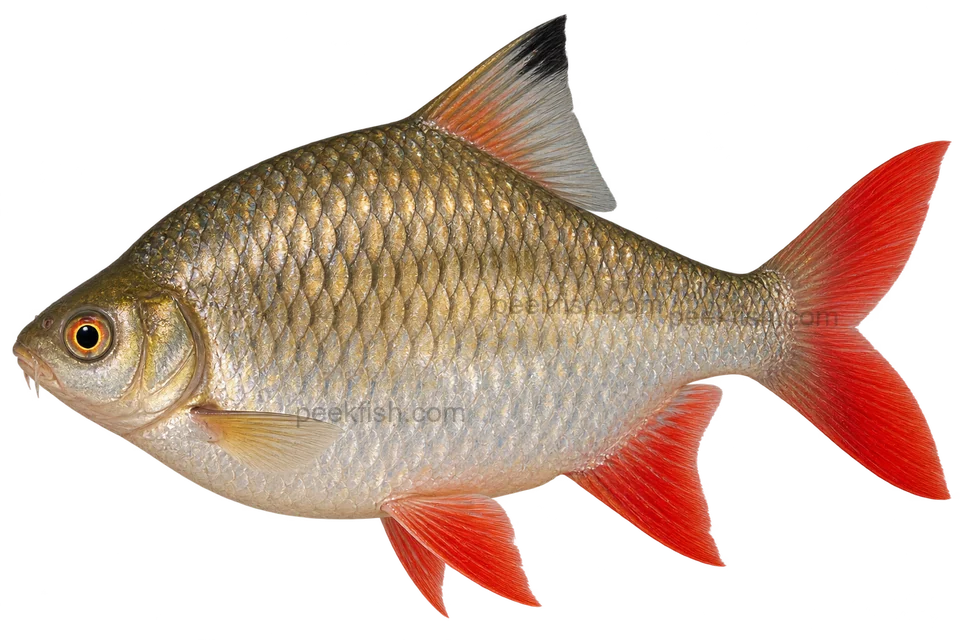
Red-tailed tinfoil barb
Bronze-toned, deep-bodied and red-tailed, without black tail-lobe stripes.
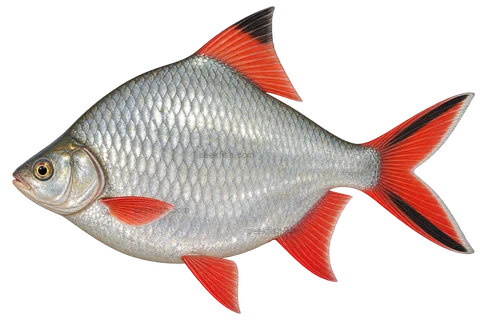
Both this fish and B. schwanefeldii are traded as tinfoil barbs. The ordinary red-tailed tinfoil barb lacks the conspicuous black tail-lobe stripes and often develops a bronze-gold adult hue. Being the smaller of the two does not make it a small aquarium fish.
- Length and basis
- Typical adult TL unknown · source 21 cm SL
- Reference temperature
- 20–27 °C
- Captive lifespan
- Unknown (no verified lifespan adopted)
- pH
- 6–8 (source care reference)
- Hardness
- 2–15 dGH (source care reference)
Small juveniles grow into active large-tank group fish. Small tankmates may be eaten and slow feeders disturbed. The species can leap when startled, so provide a secure, close-fitting cover.
Appearance and identification
Natural adults have a deep body, red pelvic and anal fins, red distal tail lobes and a black distal dorsal mark. Compare natural tail pattern and adult colour together; ornamental colour strains are recorded separately and do not add species.
Same-species behaviour
The profile recommends at least six conspecifics; insufficient numbers can contribute to skittishness or aggression. No fish-per-litre formula is inferred.
Space requirements
The profile gives a minimum 150 × 60 cm base. Plan extensive open swimming space, oxygenation and filtration around at least six adult conspecifics. This starting footprint is not a capacity guarantee for six fish.
Diet and feeding
Offer a varied diet with substantial vegetable material, appropriate dried foods and moderate animal foods while controlling the total ration. Ability to eat small fish does not justify routine live-fish feeding.
Compatibility limits
Consider robust, similarly sized companions only with adequate space. Smaller fish may be eaten and timid or slow feeders can be disturbed by its activity.
Aquarium environment
Plant material is part of its diet, so delicate planted displays should not be assumed safe from grazing. Adult space and water quality come first. Shrimp safety and exact plant damage are unverified.
Similar and related fish
Measurement notes and sources
The profile maximum is 21 cm standard length, excluding the tail. Typical adult total length for the illustrated sex and stage is unverified.
www.seriouslyfish.com ↗ 2026-10-22
api.gbif.org ↗ 2026-10-22
researcharchive.calacademy.org ↗ 2026-10-22
www.seriouslyfish.com ↗ 2026-10-22