 EN ▾
 ZH
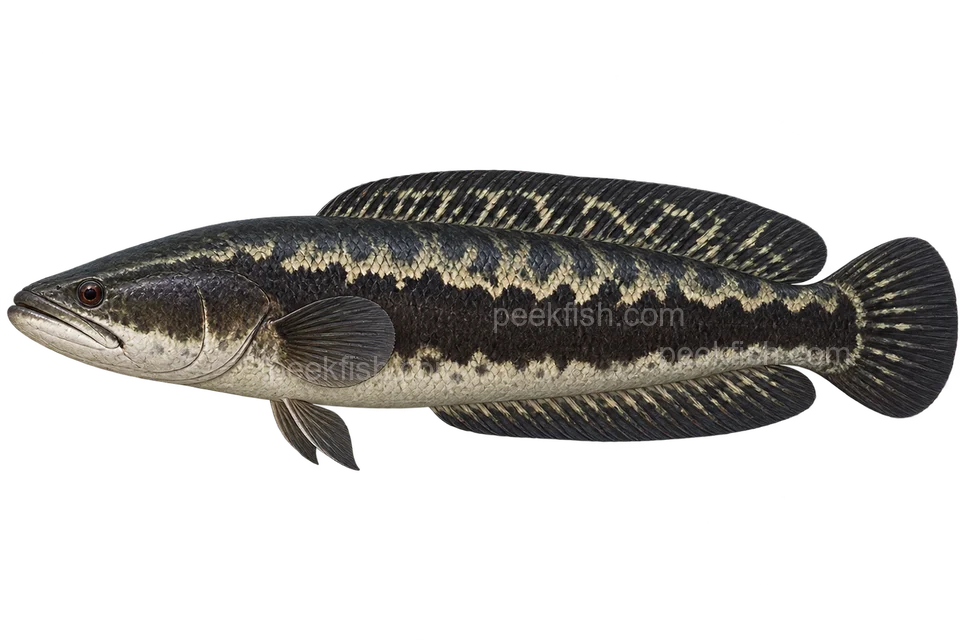
Giant snakehead
Red-striped juveniles become very large, dark predators
The adult has a broad powerful head, large mouth and robust elongated body. Dark brown-black markings and pale mottling replace the bright orange-red juvenile stripe. The main illustration deliberately represents the adult stage.
- Adult length
- About 50 cm (standard length, without the tail fin)
- Water temperature
- 25–28 °C
Maximum-size reports exceed 130 cm. This is not a small community-aquarium fish; a juvenile needs a credible permanent facility and management plan for a very large adult.
Appearance and identification
This Southeast Asian freshwater species changes markedly with age. The importer reports colour transition around 15–20 cm without a length convention. Juveniles resemble C. diplogramma; a later taxonomic study separated the species using morphology and DNA, so a red stripe alone cannot verify identity.
Adult space
Provide substantial swimming, turning and maintenance space, secure escape prevention and continuous surface access. A verified minimum base is unavailable; neither a guessed volume nor present juvenile size establishes a long-term plan.
Diet and feeding
Plan suitable animal foods and waste management for a piscivorous predator. Predation does not establish a requirement for live feeder fish. A complete feeding schedule remains unverified.
Same-species behaviour
The importer describes schooling juveniles and increasing aggression with growth, while an older field synthesis also reports group feeding in larger fish. These contexts do not prove permanent schooling or absolute solitude. Aquarium combinations require observation and separation capacity.
Compatibility limits
Small peaceful fishes are not default companions. Predation, injury and brood defence can change through development; a quiet juvenile combination is not a lasting guarantee.
Aquarium environment
Adult movement and maintenance take priority in the layout. Field breeding accounts describe vegetation clearing; plant safety and shrimp compatibility are unverified.
Sources
www.aquariumglaser.de ↗ 2026-10-22
researcharchive.calacademy.org ↗ 2026-10-22
journals.plos.org ↗ 2026-10-22
pubs.usgs.gov ↗ 2026-10-22