 EN ▾
 ZH
Flying fox
Gold over black, dark white-edged fins, and increasing territoriality with age.
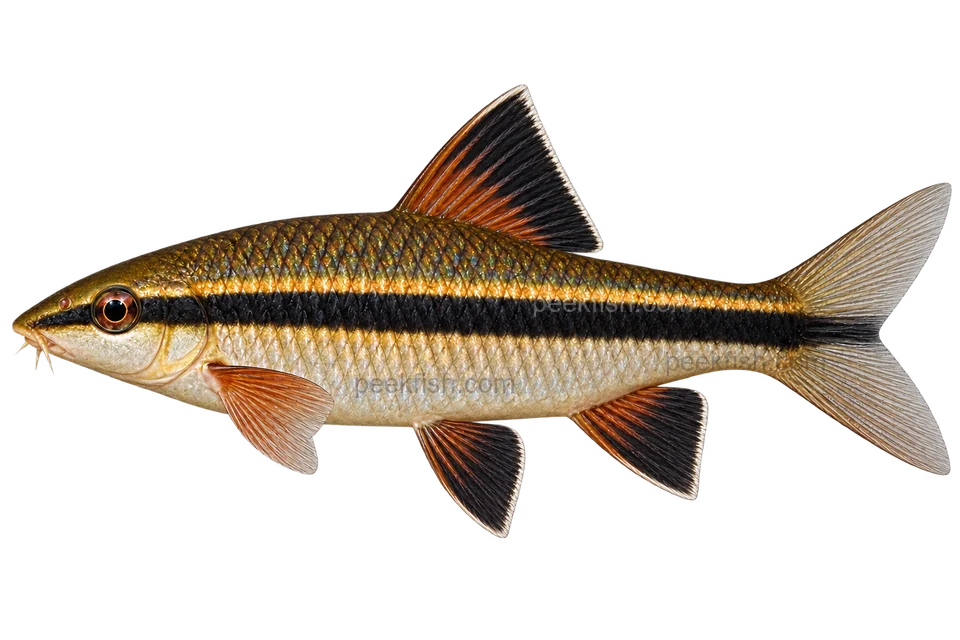
The ordinary flying fox has an olive-brown back, pale silver belly and a golden line immediately above its black side stripe. Dark and reddish fins with white edging and two pairs of short barbels help distinguish it.
- Adult length
- Up to 16 cm (standard length, without the tail fin)
- Water temperature
- 20–26 °C
- Lifespan
- 10–15 years
- pH
- 6–7.5
- Hardness
- 2–12 dGH
- Natural habitat
- Inhabits rivers and streams over sand or rock, moving into flooded plains or forest during the wet season.
Larger fish may chase congeners and similar-looking species. A hiding, quiet juvenile does not mean a peaceful adult.
Appearance and identification
The name is often used for other striped algae grazers such as Crossocheilus, Garra and Gyrinocheilus. Check fins, barbels and mouth structure together rather than the black stripe alone.
Same-species behaviour
Usually keep one flying fox. Keeping several needs a very large tank and ample cover.
Space requirements
Start at a 120 × 45 cm base, with substantially more space and separated territories for several fish. Provide rocks and wood for cover, open movement space, mature clean water, high oxygen and moderate flow.
Diet and feeding
Biofilm grazing includes small animals as well as algae. Feed a varied diet with plant-containing foods and small frozen or live foods. Aquarium algae alone are not enough and algae removal is not guaranteed.
Compatibility limits
Adults may attack congeners and similar-looking Crossocheilus, Garra or Gyrinocheilus, and harass other bottom dwellers. Assess each tankmate and keep a way to separate fish.
Aquarium environment
Soft-leaved plants are usually unharmed; attached plants suit the layout. Plants do not remove territorial conflict or oxygen demands.
Similar and related fish
Sources
www.seriouslyfish.com ↗ 2026-10-25
www.seriouslyfish.com ↗ 2026-10-22
api.gbif.org ↗ 2026-10-22
researcharchive.calacademy.org ↗ 2026-10-22