 EN ▾
 ZH
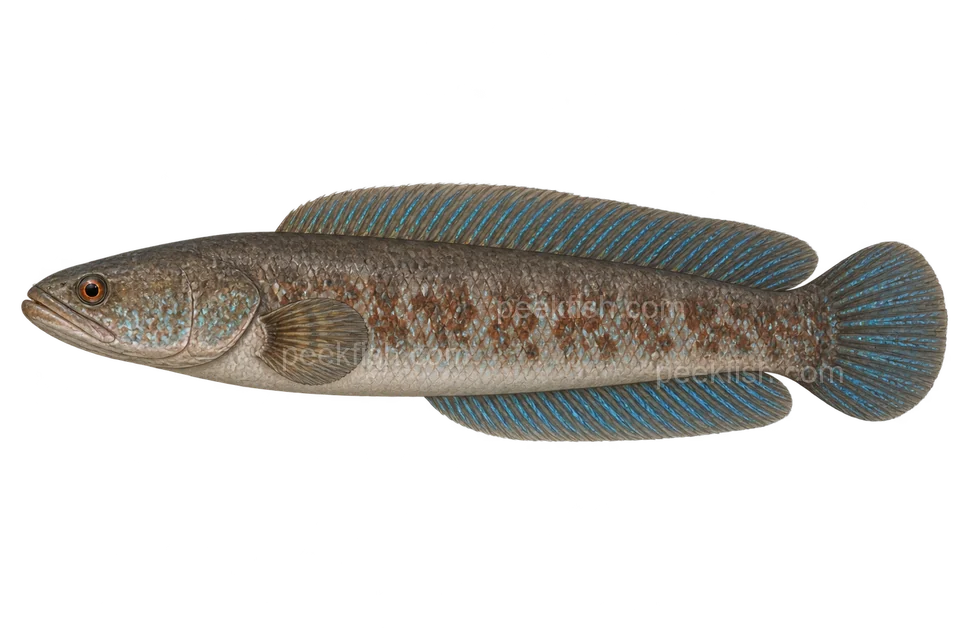
Blue rainbow snakehead
Blue extended fins and a tail without large orange patches
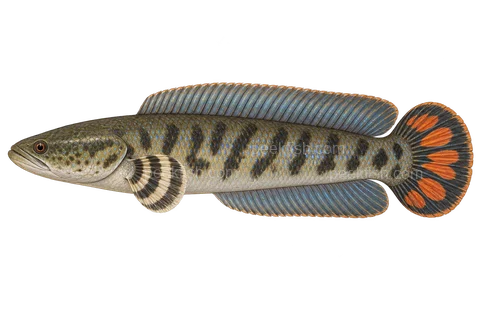
The elongated mottled body carries blue dorsal and anal fins. Pelvic fins are absent, and the tail lacks the conspicuous orange-red patches of the rainbow snakehead. This natural adult illustration is not assigned a sex.
- Length and basis
- Typical adult range unknown; reports around 10 cm, exceptionally 15 cm
- Reference temperature
- Unknown
- Captive lifespan
- Unknown (no verified lifespan adopted)
- pH
- 6–8 (source care reference)
- Hardness
- 2–20 dGH (source care reference)
A small snakehead still needs escape prevention, access to humid air and a plan for seasonal care and territorial behaviour.
Appearance and identification
Described in 2013 from Lefraguri swamp in West Bengal, this fish should be compared with C. bleheri using pelvic-fin absence and tail pattern together. Blue colour alone is insufficient. Paternal mouthbrooding also distinguishes its reproductive behaviour from the floating-egg care of C. bleheri. Use the original description and actual specimens for detailed scale and fin counts.
Adult space
Use shaded cover while keeping a clear route to the surface. A specialist profile suggests an 80 × 30 cm base for one pair; a group needs more room. This is a conditional reference, not a stocking formula.
Diet and feeding
Offer appropriately sized animal foods from reliable sources and observe acceptance of thawed foods. Adjust feeding to season and condition; predatory behaviour does not imply that live feeder fish are necessary.
Same-species behaviour
Juveniles sharing a tank can become antagonistic as they mature. Have a practical separation plan, especially when a pair begins excluding other fish.
Compatibility limits
Treat small fish and ornamental shrimp as unverified companions. Matching temperatures cannot remove predation or pair aggression.
Aquarium environment
Plants can provide cover, but this does not establish suitability for a continuously warm planted aquarium. Keep the surface accessible. Plant damage and shrimp safety remain unverified.
Similar and related fish
Measurement notes and sources
The importer reports wild fish rarely exceeding 10 cm and exceptional aquarium fish near 15 cm, without SL/TL definitions. Maturity at about 8 cm is a separate observation, not adult total length.
www.aquariumglaser.de ↗ 2026-10-22
researcharchive.calacademy.org ↗ 2026-10-22
www.seriouslyfish.com ↗ 2026-10-22
www.mapress.com ↗ 2026-10-22