 EN ▾
 ZH
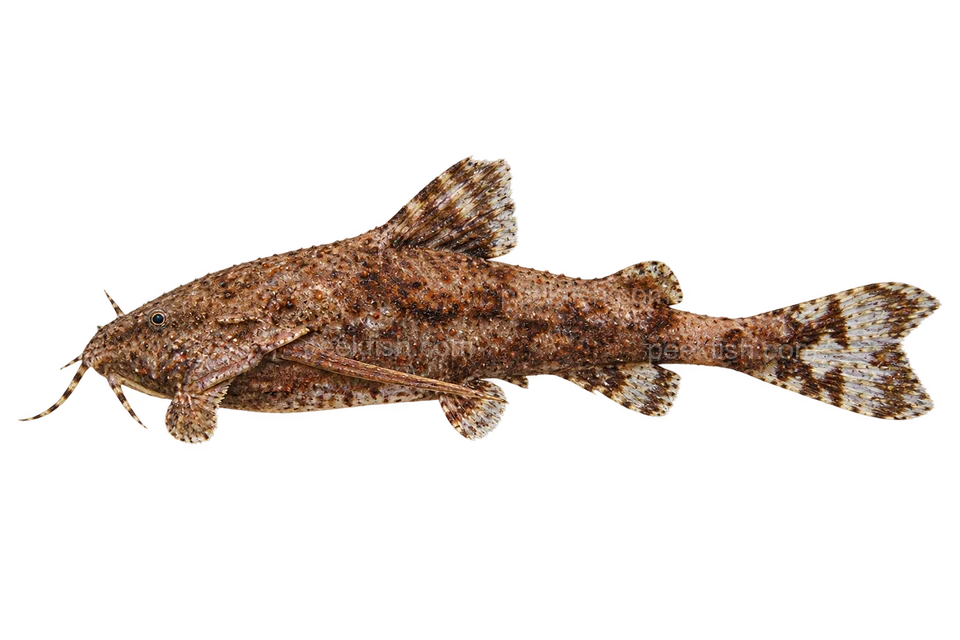
Dwarf anchor catfish
A tiny mottled catfish with long pectoral spines; check feeding after dark.
An angular low head, finely rough skin and grey to reddish-brown mottling help it disappear against the bottom. Long pectoral spines are a useful recognition cue; a small adipose fin sits behind the dorsal. Maximum standard length is 2.5–3 cm, excluding the tail fin.
- Adult length
- About 2.5 cm
- Water temperature
- 18–24 °C
- Lifespan
- 3–5 years
- pH
- 5.6–7.6
- Hardness
- 8–15 dGH
- Natural habitat
- Inhabits slow, sandy hill streams, also occurring in rivers and floodplain pools.
Appearance and identification
Compared with the banjo catfish, it has a small adipose fin and conspicuously elongated pectoral spines, and is much smaller. The banjo has no adipose fin and combines a broad flattened front with a slender tail stem.
Floor and movement space
Keep at 18–24°C, pH 5.6–7.6 and 8–15 dGH. Provide soft sand, shade and shelters with clean, well-oxygenated water; a forceful current is not a substitute for oxygenation.
Aquarium environment
Plants and moss can provide daytime shelter; keep sandy feeding areas accessible. It is not a cleaning animal.
Diet and feeding
Offer small live or frozen food after lights out and check intake. Do not assume that pellets alone are being eaten.
Same-species behaviour
Keep with its own kind.
Compatibility limits
Active bottom fish can outcompete it. Even with small peaceful companions, monitor access to food and disturbance.
Sources
www.fishbase.se ↗ 2026-10-25
www.seriouslyfish.com ↗ 2026-10-22
www.scotcat.com ↗ 2026-10-22
researcharchive.calacademy.org ↗ 2026-10-22
www.scotcat.com ↗ 2026-10-22
api.gbif.org ↗ 2026-10-22