 EN ▾
 ZH
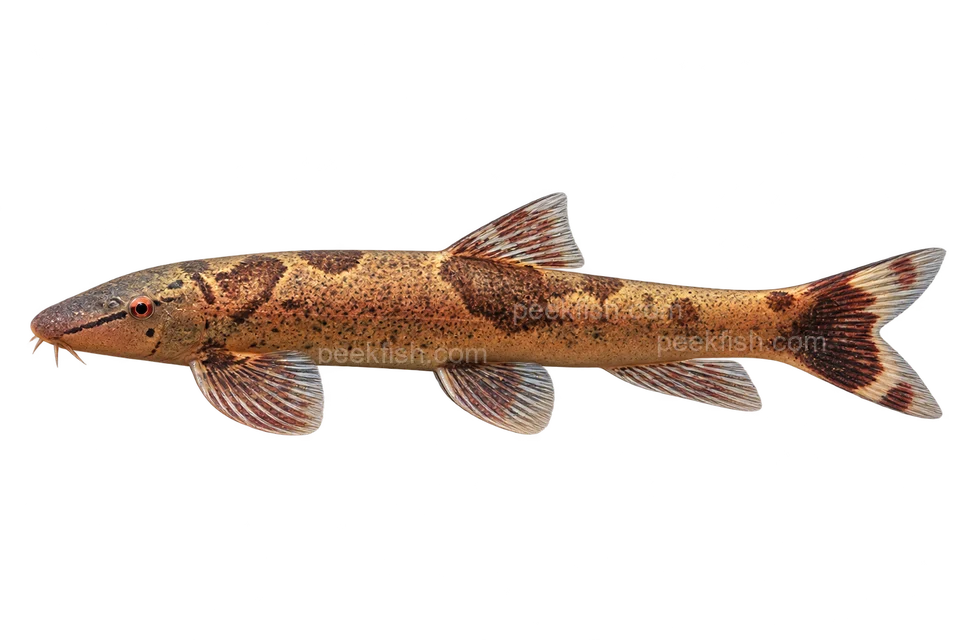
Homaloptera confuzona
Irregular saddles on a brown body; a gecko-loach label does not confirm identity
An elongated body and low head carry about four irregular dark markings on a yellowish to reddish brown ground; some marks may be missing. The dorsal-base mark is broad, the mark above the anal fin is irregular, and the caudal-peduncle mark continues onto the caudal base and lower lobe. A snout-to-eye-to-nape stripe and an oblique eye-to-throat stripe provide further clues.
- Adult length
- Up to 6.8 cm (standard length, without the tail fin)
- Water temperature
- 20–25.5 °C
- Native range
- Native to the Mekong below Khone Falls in Laos and Cambodia and small coastal basins in southeastern Thailand.
- Natural habitat
- Fast, clear, oxygen-rich streams and headwaters with riffles, gravel, rocks and bedrock bearing biofilm.
Keep at 21–25.5°C, pH 6.5–7.5 and 1–12 dGH, with flow and strong oxygenation. Reaches about 85 mm SL.
Appearance and identification
H. orthogoniata has broader, more regular, more sharply edged saddles usually reaching the lower half of the body. H. confuzona varies more, often with marks restricted to the upper half. H. parclitella can also be confused with it. Scale-keel details require close views or specimens.
Floor and movement space
Use a 120×30 cm footprint for long-term care, with feeding surfaces and flow.
Aquarium environment
Flow-tolerant attached plants such as Anubias and Java fern can provide resting surfaces; keep rocks and mature biofilm. New tanks or oxygen-poor still-water planted setups are not suitable. Use a tight cover because the fish can climb glass; secure openings and gaps.
Diet and feeding
Provide mature grazing surfaces and regular small frozen or live invertebrate foods; see whether sinking dry foods are accepted. It is not simply an algae-removal fish. Feeding rushes can push smaller fish aside, so check weaker individuals get food.
Same-species behaviour
Keep six or more; individuals gather facing the current at certain times.
Compatibility limits
Usually peaceful, but feeding competition and oxygen needs constrain combinations. Watch smaller fishes' access to food.
Sources
api.gbif.org ↗ 2026-10-23
www.fishbase.se ↗ 2026-10-25
www.fishkeeper.co.uk ↗ 2026-10-23
www.hiranya.me ↗ 2026-10-23
www.loaches.com ↗ 2026-10-23
www.seriouslyfish.com ↗ 2026-10-23