 EN ▾
 ZH
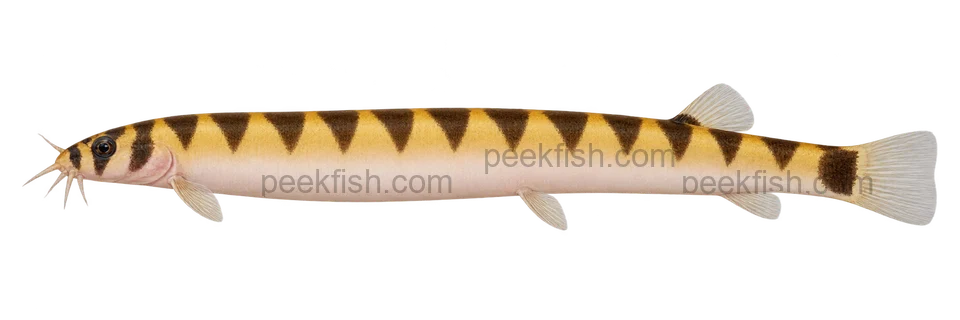
Dwarf kuhli loach
Small eel loach with wedge-shaped saddles above a pale lower flank.
Dark saddles mainly occupy the yellow upper half, leaving a distinctly pale lower flank. Nasal barbels, a dark caudal-base blotch and a nearly truncate translucent tail help identify it. Size or band count alone is not enough.
- Adult length
- Up to 6 cm (standard length, without the tail fin)
- Water temperature
- 21–26 °C
- pH
- 3.5–7
- Hardness
- 0–8 dGH
- Natural habitat
- Inhabits shaded forest creeks, swamps and backwaters, in blackwater or clearwater, often among leaves over peat, mud or sand.
Keep at 21–26°C, pH 3.5–7.0 and GH 0–8 dGH; do not acidify every aquarium to an extreme. Reaches 40 mm SL.
Appearance and identification
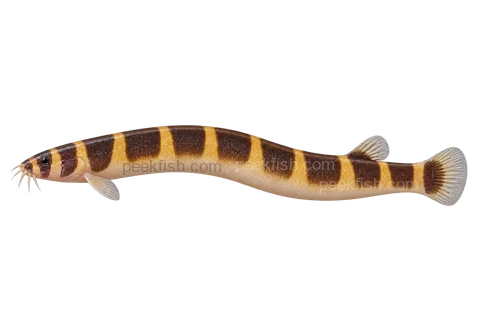
Compare its upper-body wedges, nasal barbels and nearly truncate tail with P. semicincta. The closer P. malayana needs nasal-barbel and tail-shape checks together. Dwarf, zipper and kuhli trade names may be mixed, and semicincta has turned up in shipments of this species.
Floor and movement space
At least 45×30 cm base or equivalent, with a group, soft sand, cover and feeding access.
Aquarium environment
A shaded, gently flowing planted layout with soft sand and accessible bottom gaps. Avoid coarse gravel that hinders burrowing, protect intakes, secure escape gaps and maintain surface gas exchange.
Diet and feeding
Offer small sinking meals and varied small live or frozen foods suitable for its mouth. Check that hidden individuals feed; sand-sifting and taking leftovers do not replace feeding.
Same-species behaviour
Keep at least 5–6. Provide quiet shared refuges and several feeding spots, and check that smaller fish are not outcompeted.
Compatibility limits
Avoid predators able to swallow small loaches and aggressive bottom competitors. Eggs and fry may be eaten. It is not an algae, snail or cleaning solution.
Similar and related fish
Sources
www.seriouslyfish.com ↗ 2026-10-22
www.aquariumglaser.de ↗ 2026-10-23
api.gbif.org ↗ 2026-10-22