 EN ▾
 ZH
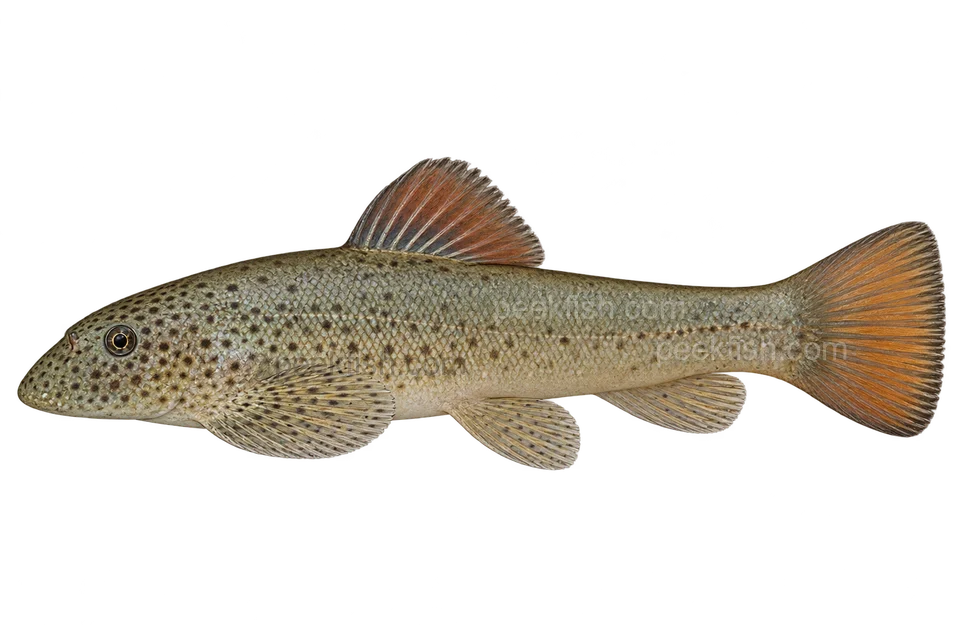
Pseudogastromyzon laticeps
A broad low head and variable fin colours; purple fins alone do not identify it
The head is broad and low with a relatively flat underside. Bodies range from pale to dark, with nearly plain sides, fine spots, irregular markings or fine bars, and fin colours vary with region and display. One form is subdued olive with reddish-brown dorsal and caudal fins.
- Adult length
- Up to 6.7 cm (standard length, without the tail fin)
- Water temperature
- 18.9–23.9 °C
- Natural habitat
- Endemic to the Longjin He drainage in Guangdong, China.
Needs clean, oxygen-rich moving water. Keep at pH 6.0–7.5 and 1–12 dGH. Maximum 67 mm SL.
Appearance and identification
Purple, blue or red fins alone cannot identify the species. The second lower-lip ridge is bimodal, unlike the unimodal ridge of P. fasciatus and P. cheni. The former P. lianjiangensis is included in the same species.
Floor and movement space
Allow a 75 × 30 cm base or equivalent for six or more. Feeding surfaces, refuges and competition also matter.
Aquarium environment
Flow-tolerant attached plants such as Anubias and Java fern can be used, but they do not replace mature feeding surfaces. Provide flow, aeration, stable water quality and a secure cover against climbing escapes.
Diet and feeding
Feeds on attached biofilm, including small invertebrates rather than only long algae. Provide mature feeding surfaces and check it accepts sinking foods and small frozen or live foods. It is not a maintenance-free cleaning tool.
Same-species behaviour
Keep six or more to see loose aggregations and territorial behaviour. Dominant individuals can claim better feeding sites; check weaker fish get food.
Compatibility limits
Similar-looking bottom fishes may compete for feeding sites. Smaller, less dominant Gastromyzon or Hypergastromyzon may be harassed. Young shrimp may be at risk.
Sources
api.gbif.org ↗ 2026-10-23
doi.org ↗ 2026-10-23
www.fishbase.se ↗ 2026-10-25
www.sanheaquarium.com ↗ 2026-10-23
www.seriouslyfish.com ↗ 2026-10-23