 EN ▾
 ZH
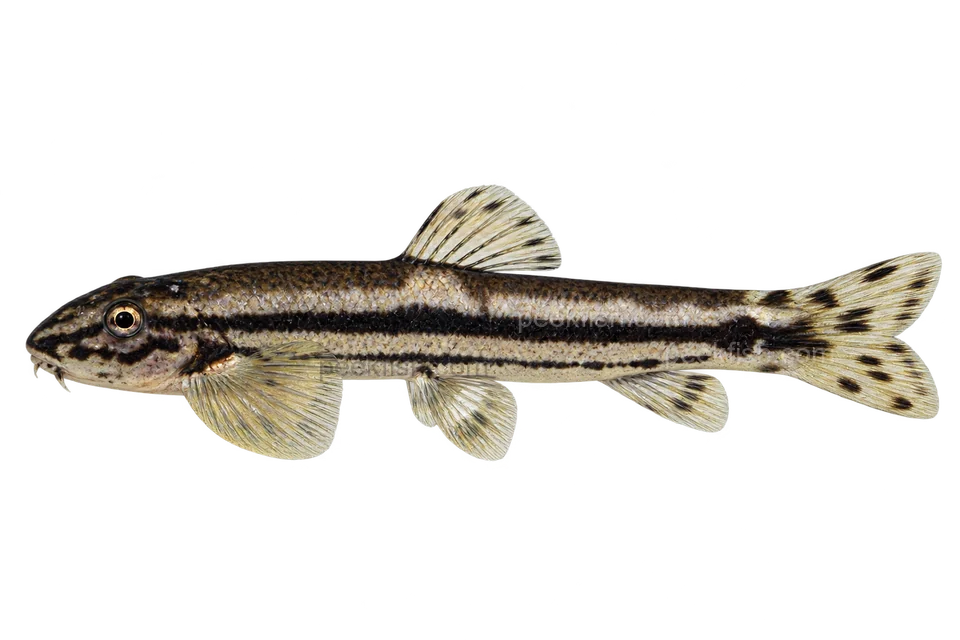
Panda loach
Juvenile panda bars change into adult longitudinal markings
Bold juvenile black-and-white bars connect and fade as the fish grows. Adults develop a dark back, a midlateral stripe and a thinner lower stripe with pale elongated spaces between them. Individuals vary.
- Adult length
- Up to 5.8 cm (standard length, without the tail fin)
- Water temperature
- 15.5–24 °C
- Natural habitat
- Occurs in rivers and streams.
Keep at 20–23.9°C, pH 6.5–7.5 and 2–15 dGH. Clean, stable, oxygen-rich flowing water is essential. Maximum 60 mm SL.
Appearance and identification
Adult longitudinal markings contrast with the row of low square flank blotches in Erromyzon kalotaenia. Yaoshania has an enlarged lip lamina connecting the upper lip and maxillary barbel at the mouth corner. Protomyzon pachychilus is an old combination, and a Gold Line trade label does not add another species.
Floor and movement space
Allow a 60×30 cm footprint for a small group; avoid tiny nano tanks. Feeding surfaces, refuges and flow distribution also matter.
Aquarium environment
Flow-tolerant attached plants such as Anubias and Java fern can be used while retaining food-bearing rocks. Dense still-water or newly established tanks are not suitable. It can climb glass: use a tight cover and close escape gaps.
Diet and feeding
Provide mature grazing surfaces plus suitable sinking foods, vegetable ingredients and some small frozen or live foods. It is not a maintenance-free cleaner. Check that thin new arrivals eat and can reach food.
Same-species behaviour
Keep four or more for loose aggregations; they defend feeding patches.
Compatibility limits
Not generally aggressive, but food competition restricts combinations. Check each species.
Sources
api.gbif.org ↗ 2026-10-23
aquaticarts.com ↗ 2026-10-23
doi.org ↗ 2026-10-23
www.fishbase.se ↗ 2026-10-25
www.seriouslyfish.com ↗ 2026-10-23