“The water is fine” is more useful as a dated record of measurements, units and methods. Clear water, or a pH test alone, cannot establish that every relevant parameter is suitable. This guide covers sampling, reading and recording results; it does not offer one set of numbers for every fish.
Check what the kit actually measures
Read the contents rather than assuming that “multi-test” or “complete” includes ammonia. Common freshwater checks include ammonia, nitrite, nitrate, pH and temperature. Hardness, buffering capacity, disinfectant residuals and other parameters depend on the water source, species and problem. New setups, increased loads, filter changes and unusual fish behaviour call for more targeted checks.
Test ranges and units differ. Ammonia reporting may distinguish total ammonia, un-ionised ammonia and results expressed as nitrogen. Preserve the kit’s full parameter name and unit. A result beyond the scale is not necessarily equal to the highest printed value; follow the instructions for further assessment or use an appropriate method.
Make the procedure repeatable
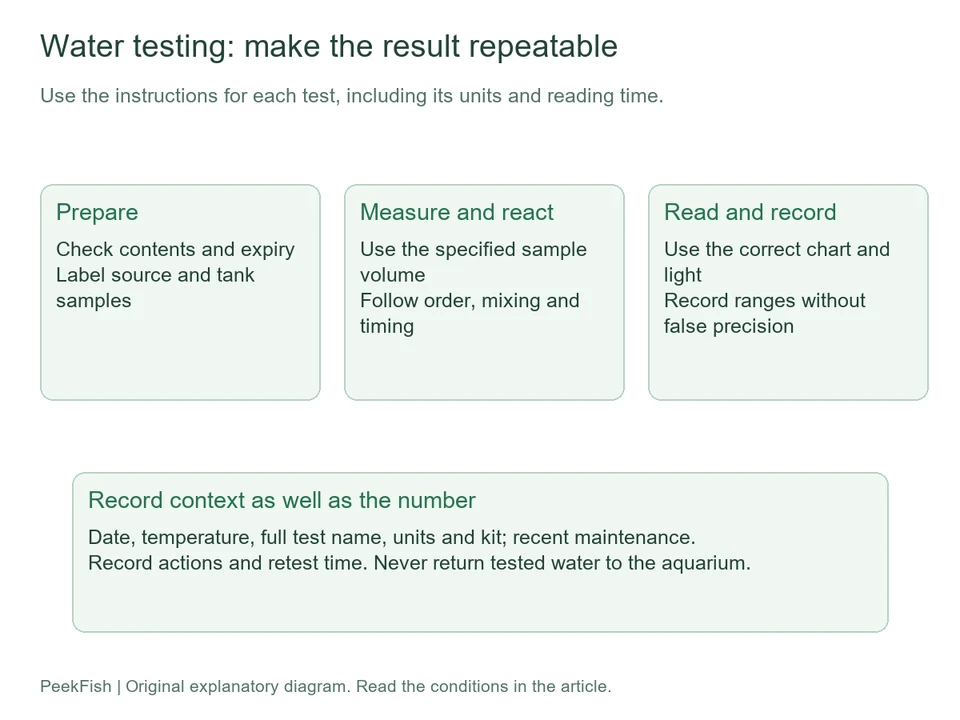
- Inspect the reagents: Check expiry, storage conditions and labels. Read the instructions for this particular test; different tests do not necessarily use the same shaking or waiting time.
- Prepare containers: Clean tubes as instructed, avoiding detergent or previous-reagent residues. Label aquarium and source-water samples separately.
- Measure the sample: Fill to the specified mark where the level is easy to see. Do not substitute an estimated half tube.
- Perform the reaction: Add the correct reagents in order, mix and time as directed. Do not omit a second bottle or add extra drops to compensate for uncertainty.
- Read on time: Use that product’s chart, viewing direction and suitable light. A photograph taken too early or much later may not represent the required reading time.
Do not pour tested samples back into the aquarium. Handle reagents, waste and tubes according to the product instructions and local requirements, away from children and pets. Keep testing equipment separate from food containers.
If colours are unclear, check the method first
A result between chart steps can be recorded as a range rather than an invented decimal. Lighting, phone white balance and screens affect photographs: they can document context but are not automatically more accurate than an appropriate direct comparison. When a reading differs greatly from earlier results, repeat with a fresh sample and check for wrong reagents, missed mixing steps or expired products.
Testing aquarium water and untreated or prepared source water on the same day can help identify where a change originates. A strip labelled satisfactory cannot rule out a source-water problem unless the relevant parameter was actually tested.
Record enough detail to compare later
| Time and context | Measurement | Subsequent action |
|---|---|---|
| Date, before or after a water change, recent additions, feeding or filter work | Full parameter name, reading or range, unit, kit name and temperature | Litres changed, equipment adjustments or other treatment, and retest time |
Choose comparable points in the routine. Readings before water changes can help track a maintenance interval; after an incident, record the time between treatment and retesting. One reading cannot reconstruct whether a problem occurred several days earlier.
Use the results to decide the next action
Detected ammonia or nitrite, visibly distressed fish or a persistent adverse trend calls for investigation of feeding, filtration, source water and temperature, with timely action appropriate to the situation. Avoid combining multiple water-treatment products merely to produce a preferred colour. When seeking professional help, provide the record together with actual water volume, species and numbers, symptoms and recent changes. That is more informative than “all parameters normal”.
Sources
- API Fishcare: kit contents, instructions and questions
- UF/IFAS: ammonia testing and interpretation
- UF/IFAS: history and environmental information for diagnosis