Cycling an aquarium is not a countdown that makes adding fish safe when it ends. The aim is to establish a system that can consistently process nitrogenous waste at the planned load. This freshwater guide explains the evidence to use; clear water, a week of running the filter or a dose of bacteria is not proof by itself.
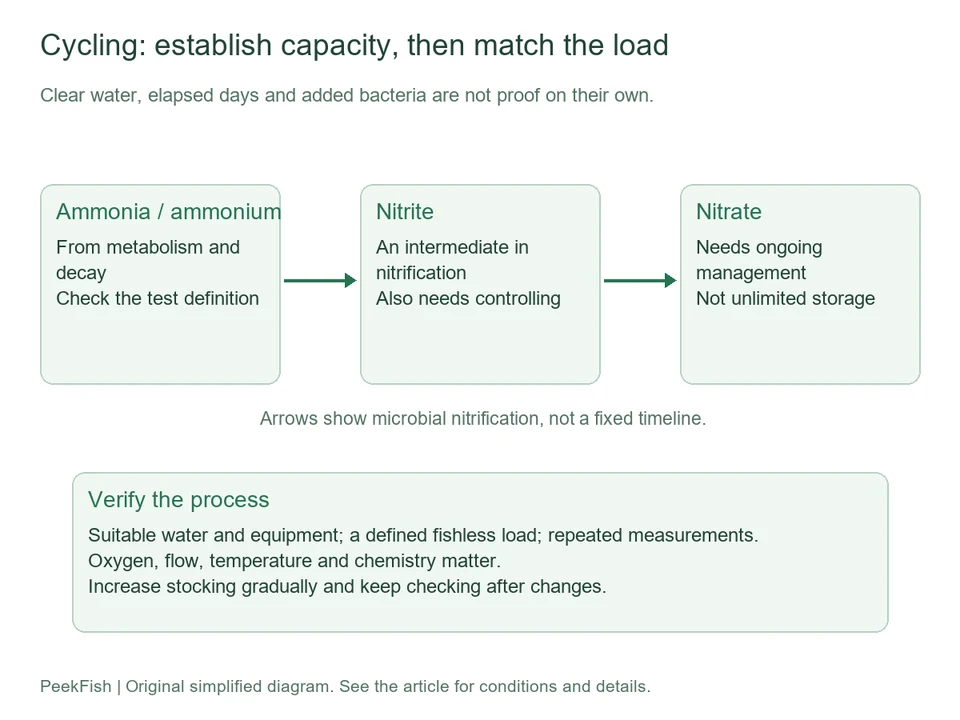
What happens to the food entering the aquarium?
Fish metabolism releases ammonia, while decomposing food and other organic material also contribute waste. A pad can trap particles without removing ammonia already dissolved in the water. In biological filtration, microorganisms convert ammonia to nitrite and then nitrate: nitrification. Nitrite also needs controlling, and nitrate is not an end product that can accumulate without limit.
Interpret ammonia according to the test definition. Many kits report total ammonia, combining forms with different toxicity; the risk associated with a reading changes with temperature and pH. The absence of smell or haze cannot rule out ammonia.
Why a running filter may not be ready
Microorganisms need suitable surfaces, a usable nutrient supply and appropriate conditions. Flow, oxygen and water chemistry are part of biological-filter operation. Running an empty aquarium with clean water, without a defined establishment and verification process, does not demonstrate capacity for a new group of fish.
Temperature, source water, inoculating material and the startup method influence progress. Mature media or commercial bacterial products may help, but their origin, transport, storage and use matter. Adding a product does not complete verification. Media from an uncertain source may also introduce unwanted organisms.
Establish the filter without fish and keep records
Prefer a reliable, complete fishless method. Use a nitrogen source explicitly suitable for that method and follow its instructions. Do not substitute household ammonia of unknown composition or containing fragrances or cleaning additives, and do not use fish to test whether the water is harmful.
- Confirm equipment, water treatment and temperature conditions; record source-water and tank baselines.
- Apply the controlled load specified by the chosen method. Record quantities and times rather than mixing incompatible dosing schemes.
- Track ammonia, nitrite, nitrate and relevant pH and temperature changes. Investigate method and environment when progress is abnormal.
- Verify repeated processing of the defined load as the method requires, rather than relying on one reading.
- Before adding fish, address residuals and water differences and confirm conditions appropriate to the actual species.
Recognise incomplete evidence
| Observation | What is still needed |
|---|---|
| Clear water | Measurements and demonstrated processing capacity |
| No detected ammonia or nitrite | Evidence of a preceding known load and valid tests |
| Detected nitrate | Source-water baseline and confirmation that ammonia and nitrite are controlled |
| Someone else’s product worked in three days | This aquarium’s conditions and measurements |
Plants and other uptake pathways can change nitrate trends from a simplified diagram. There is no single curve every tank must reproduce, and one number alone cannot establish readiness.
Match the load after fish are introduced
Startup verification does not establish capacity for unlimited additions. Increase the planned load gradually and keep testing and observing. Many new fish, excess food, stopped filtration or extensive cleaning can change the balance. If fish are already present and ammonia or nitrite becomes a problem, respond to the actual risk in an occupied system. Do not continue adding a fishless-cycling nitrogen source.
Sources
- UF/IFAS: ammonia, nitrification and test interpretation
- UF/IFAS: recirculating-system startup and maintenance