An occasional trip to the surface to feed or breathe is different from persistent, unusually rapid breathing in several fish. Bettas and other air-breathing fish cannot be diagnosed as oxygen-deprived from a single surface visit. Look for a clear, sustained change from normal behaviour, particularly when several animals are affected.
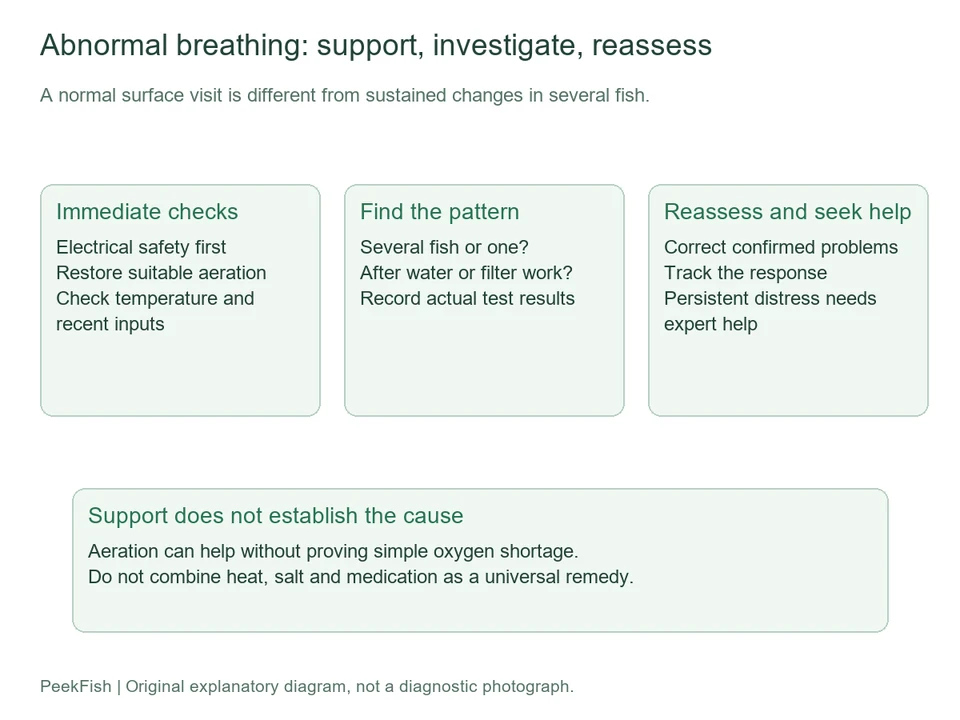
With widespread distress, check the environment immediately
Do not spend a long time photographing fish before checking filtration, circulation, air pumps and effective surface movement. Restore suitable aeration where safe. If electrical connections are wet, equipment is damaged or an electrical fault is suspected, disconnect power from a safe location rather than reaching into the water.
Check actual temperature, stop adding food and review any recent water change, CO₂ addition, medication or contact with cleaners. In a planted tank using injected CO₂, stop injection and improve gas exchange during breathing distress while investigating. Aeration is supportive action, not proof that oxygen shortage was the only cause.
Use the pattern to guide the investigation
| Pattern | Priority checks |
|---|---|
| Several species suddenly affected | Oxygen supply, temperature, new water, contamination, equipment and water quality |
| Immediately after a water change | Dechlorination, temperature difference, source-water conditions and equipment restart |
| After filter work or increased feeding | Actual flow, ammonia, nitrite and changes in biological load |
| Mainly one fish | Environment first, then injury, harassment and individual health |
Water-quality problems need not affect every individual at once. Species and individuals respond differently. Mouth movements in a video cannot distinguish every environmental irritation from every gill disease.
Replace “normal water” with measurements
Test ammonia and nitrite and record pH and temperature. Add relevant checks such as disinfectant residuals based on the source water and recent work. Measure dissolved oxygen if possible, but do not delay equipment checks because no oxygen meter is available. Record the test name, result, unit and time. A pH result or a strip without an ammonia test cannot rule out ammonia.
Where a harmful substance can be reduced by dilution, make an appropriate partial water change with reliably treated, suitable replacement water and retest. Verify a questionable source first. A long-neglected tank may have substantial chemistry differences from new water, so replacing everything immediately is not a universal remedy.
Avoid combining unrelated treatments
Low oxygen, ammonia or nitrite problems, chlorine exposure, abnormal temperature and gill disease can all involve breathing changes. Salt, increased heat and medication are not a common answer to all of them. Heating also changes oxygen demand and gas conditions. Keep a clear intervention record instead of combining products whose effects are difficult to separate.
Seek aquatic veterinary or diagnostic help promptly if breathing remains abnormal after improving aeration and correcting confirmed environmental problems, or if fish lose balance, bleed, show marked gill changes or die. Repeatedly switching medications is not a reliable diagnostic method.
Provide useful information when asking for help
- Species, numbers, actual water volume, setup age and which animals are affected.
- When the change started and whether it was sudden or progressive; recent fish additions, water changes, filter work and products used.
- Temperature, full test results and units, kit names, and whether filtration and aeration are working normally.
- Actions already taken and the response. Include clear photographs or a short video when they can be obtained safely.
Sources
- UF/IFAS: fish health and environmental management
- Merck Veterinary Manual: aquarium-fish management
- UF/IFAS: information needed for diagnosis