How long tap water should stand before use cannot be answered by a fixed number of days. First establish the local disinfectant treatment, then choose an appropriate preparation method. Water suitable for people to drink is not automatically ready to add untreated to an aquarium.
Distinguish chlorine from chloramine
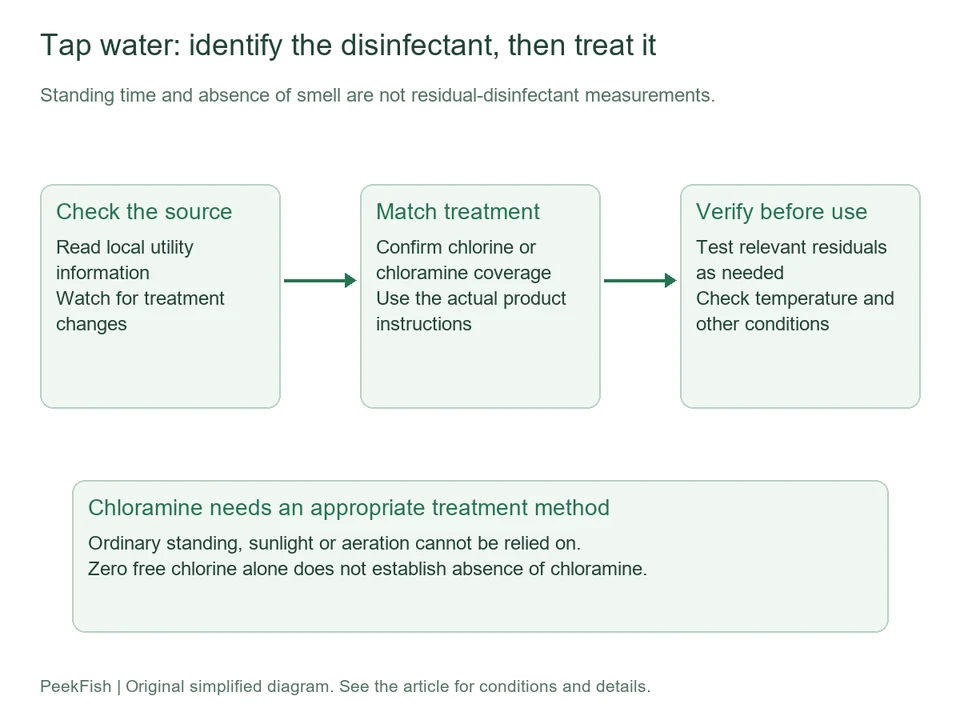
A supply may use free chlorine or the more persistent chloramine. Both require appropriate treatment for fish. Ordinary standing, sunlight or aeration cannot be relied on to remove chloramine; water utilities also warn against treating boiling as a chloramine-removal solution for aquarium water.
No detectable bleach-like smell is not a test result. Treatment can vary between places, seasons and supply changes. Another keeper’s experience with standing water does not establish what is currently coming from your tap.
Find the relevant supply information
Consult the local utility’s quality report, disinfection information and temporary notices, or ask it directly. Record the source and date. Wells, rainwater and other sources need their own assessment; lacking municipal disinfectants does not make them automatically suitable.
Check any household purifier’s actual cartridge, capacity, flow requirements and replacement history. Improving taste or removing particles does not establish effective chloramine removal or suitability for every species.
Choose treatment by what it addresses
- Intended use: Is the product for aquarium use, and does it cover the disinfectant in the supply?
- Dose basis: Do the instructions use replacement-water volume or total aquarium volume? Confirm the concentration and method.
- Sequence: Follow this product’s preparation and addition instructions rather than borrowing another brand’s dose.
- After treatment: Understand how chloramine treatment handles ammonia, how tests may respond and what processing remains necessary.
Conditioners differ in composition and strength. A cross-brand rule of a few drops per bucket is inappropriate, and combining several products is not automatically better. Correct use according to the actual instructions matters more than an uncertain extra dose.
Verify treatment and the other conditions for use
When checking residual disinfectant, use a suitable low-range method and distinguish free chlorine from total chlorine. A zero free-chlorine result alone does not prove that chloramine is absent. For ammonia, consult the test and conditioner manufacturers about interference and interpretation instead of casually dismissing a result as false.
After disinfectant treatment, assess temperature and relevant differences from the aquarium. Dechlorination is not the same as adjusting hardness, removing every contaminant or making one water source appropriate for all fish.
Make replacement-water preparation repeatable
- Use a dedicated container without cleaning-product residues and establish the actual volume.
- Confirm that the source information and treatment remain applicable; follow the label.
- Check relevant residuals, temperature and other conditions before use.
- Keep the product name, dose and unusual observations. Reassess when the supply changes or problems arise.
This process addresses preparing new water. Fish already showing abnormal breathing, loss of balance or other distress require prompt assessment of the actual risk, rather than waiting several more days for a bucket of water to stand.
Sources
- MWRA: chloramines and aquarium-water questions
- LADWP: chloramine facts
- Pennsylvania DEP: chloramine in drinking water