A filter does not automatically remove the need for an air pump, and plenty of bubbles do not prove sufficient oxygen. The question is whether oxygen available in the water meets demand under the actual temperature, stocking and operating conditions. This guide explains the principles; obvious breathing distress calls for immediate troubleshooting.
Fish use oxygen dissolved in the water
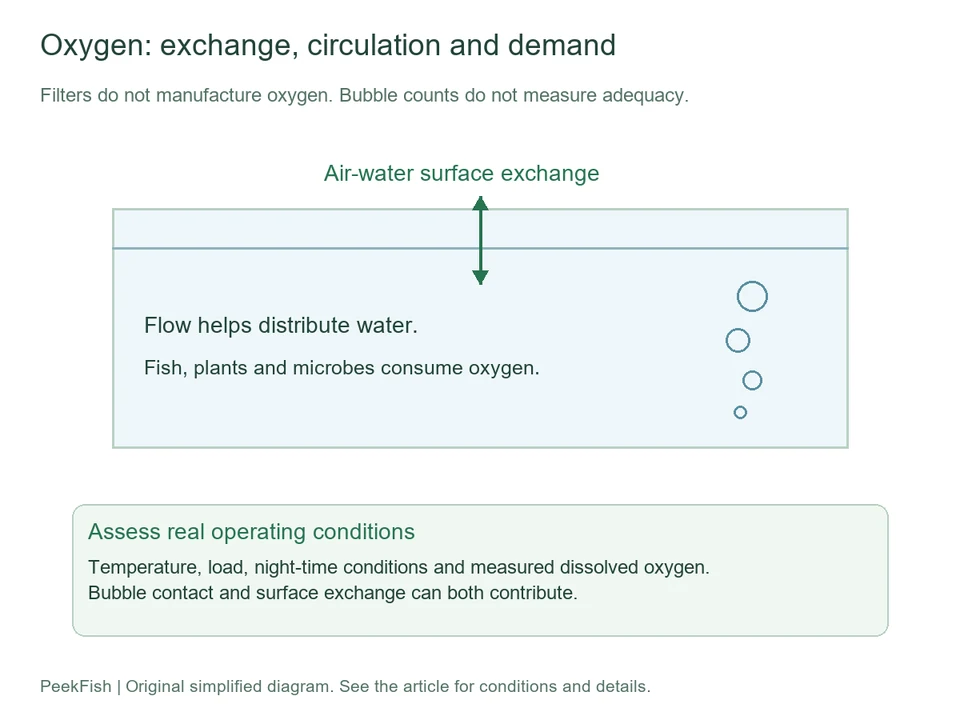
Most fish obtain dissolved oxygen through their gills. Some also breathe air, but still need appropriate water quality and conditions. Oxygen enters through air-water exchange and photosynthesis when plants or algae receive light. Fish, plants and microorganisms also consume oxygen through respiration.
A filter does not manufacture oxygen, and a few plants do not guarantee an unlimited supply. Respiration continues at night when photosynthesis does not. Normal daytime behaviour cannot establish the entire night-time situation.
Flow and bubbles have related but different roles
| Equipment or effect | Contribution | What it cannot establish alone |
|---|---|---|
| Filter output moving the surface | Renews surface water and helps circulate the tank | A large rated filter flow guarantees adequate oxygen throughout |
| Air pump and diffuser | Add air-water contact; rising bubbles move water and disturb the surface | More or larger bubbles automatically mean healthier fish |
| Underwater circulation | Improves local mixing and movement | Strong underwater current necessarily provides sufficient air exchange |
Exchange at bubble surfaces and at the water surface can both contribute. Performance depends on the equipment, depth, bubbles and circulation. It is inaccurate to explain all aeration as oxygen appearing only when a bubble bursts.
Know when to reassess oxygen arrangements
High temperature, increased animals or feeding, organic buildup and abnormal filter flow warrant renewed attention. Under otherwise comparable conditions, warmer water holds less oxygen while animal demand may rise. Medication, sick-fish care and specialised systems may have additional requirements.
If the existing outlet provides appropriate exchange and circulation and dissolved oxygen meets the animals’ needs, a separate device is not required merely to produce visible bubbles. When adequacy is uncertain, measurement and an assessment of the layout are more useful than counting bubbles.
Assess actual operating conditions
- Check outlet position, actual flow, water level and surface conditions rather than only the equipment rating.
- Observe hotter periods and night or early morning conditions; use suitable oxygen testing when needed.
- Record temperature, sampling position and instrument calibration, interpreting results for the species and system.
- Observe after adjustments. Avoid making the current so strong that fish struggle continuously or cannot feed normally.
A CO₂-injected planted tank needs coordinated management of gas exchange, CO₂ input and animal behaviour. Conserving injected gas does not justify ignoring breathing distress. Excess CO₂ can itself be a problem; not every case is simply oxygen shortage.
Separate everyday operation from outage backup
A filter providing suitable daily circulation can still stop during a power cut. Test backup aeration, power and runtime separately. Install additional air equipment with the manufacturer’s backflow protection, secure placement and electrical instructions so that a temporary solution does not create a leak risk.
Sources
- UF/IFAS: oxygen sources, daily changes and temperature
- UF/IFAS: emergency aeration and circulation
- Merck Veterinary Manual: environmental history and gas measurements