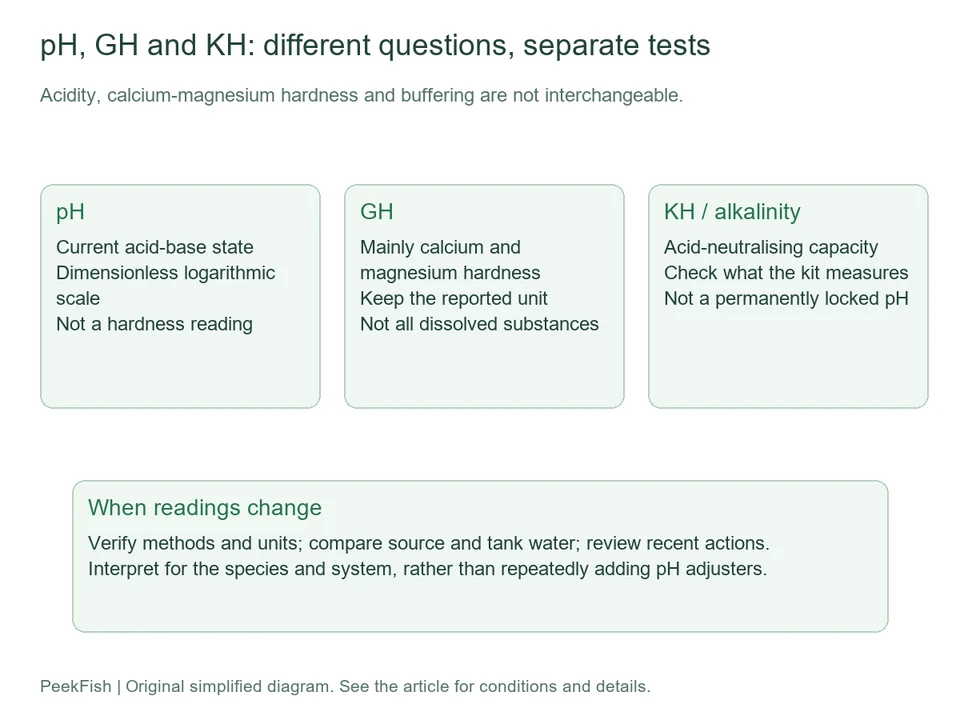
pH, GH and KH describe different properties. Basic water, hard water and strong buffering may occur together, but one measurement cannot replace the others. Understanding the distinction helps interpret species requirements, compare supplies and investigate change instead of continually adding products to chase a preferred set of numbers.
Separate the three questions
| Parameter | Main meaning | Common reporting |
|---|---|---|
| pH | The current acidity or basicity | A dimensionless logarithmic scale |
| GH: general hardness | Primarily calcium and magnesium hardness | Degrees GH or mg/L expressed as CaCO₃ |
| Aquarium KH | Usually used to assess acid-neutralising capacity associated with the carbonate system | Degrees KH or mg/L expressed as CaCO₃ |
Aquarium KH tests commonly measure total alkalinity. This is not identical in every sample to carbonate hardness in its strict chemical sense. Retain the test name, parameter and units rather than simply recording “hardness 6”.
pH describes a state; buffering affects resistance to change
Think of pH as the current reading and alkalinity as a measure of the water’s ability to neutralise added acid. Two samples with the same pH can respond differently to the same acid input. Bicarbonate and other substances contribute buffering, but it is not a lock that keeps pH permanently fixed.
Because pH is logarithmic and water contains buffering systems, mixing pH 6 and pH 8 water does not automatically produce pH 7. Composition and proportions matter. Likewise, “alkalinity” in a water report is not simply another word for a high pH.
Why GH and KH need separate measurements
A KH-related measurement does not automatically tell you calcium and magnesium content. Sources, mineral mixtures and treatment methods can change the relationship. Conductivity or a TDS reading reflects a wider range of dissolved ions and cannot replace GH, KH or ammonia testing.
One German degree of hardness corresponds to approximately 17.8 mg/L expressed as CaCO₃. That is an equivalent reporting amount, not a claim that the water contains that weight of suspended calcium carbonate. Confirm the kit’s units before converting; do not mix them with unrelated reporting conventions such as nitrogen-based measurements.
When a reading changes, compare the right things
- Check reagent expiry, method, range and units, and repeat when needed.
- Compare source and aquarium water; record water changes, top-offs, rocks, substrate and additives.
- Compare pH at similar times where possible and record lighting and CO₂ operation.
- Interpret changes alongside species needs, animal behaviour and other measurements instead of a universal target.
Long-term maintenance problems, depleted buffering and supply changes all warrant investigation. Repeated pH-up or pH-down dosing can obscure the cause rather than resolve it. Understand replacement-water preparation and system stability before adjusting.
Choose appropriate conditions before deciding on water mixing
A species range needs context: routine keeping, breeding and different life stages are not interchangeable, and the endpoints are not automatically suitable daily targets. Special soft-water, hard-water or breeding requirements call for a repeatable preparation and measurement method. Unprepared pure water, casual mineral additions and universal pH recipes cannot replace that process.
Sources
- USGS: alkalinity and buffering
- USGS: minerals and water hardness
- Aquarium Co-op: aquarium pH, GH and KH