Topping off mainly restores water lost to evaporation. A water change removes some aquarium water and replaces it with suitable new water. Both involve pouring water in, but they differ in what leaves the system and cannot substitute for each other. This guide explains the distinction for freshwater aquariums.
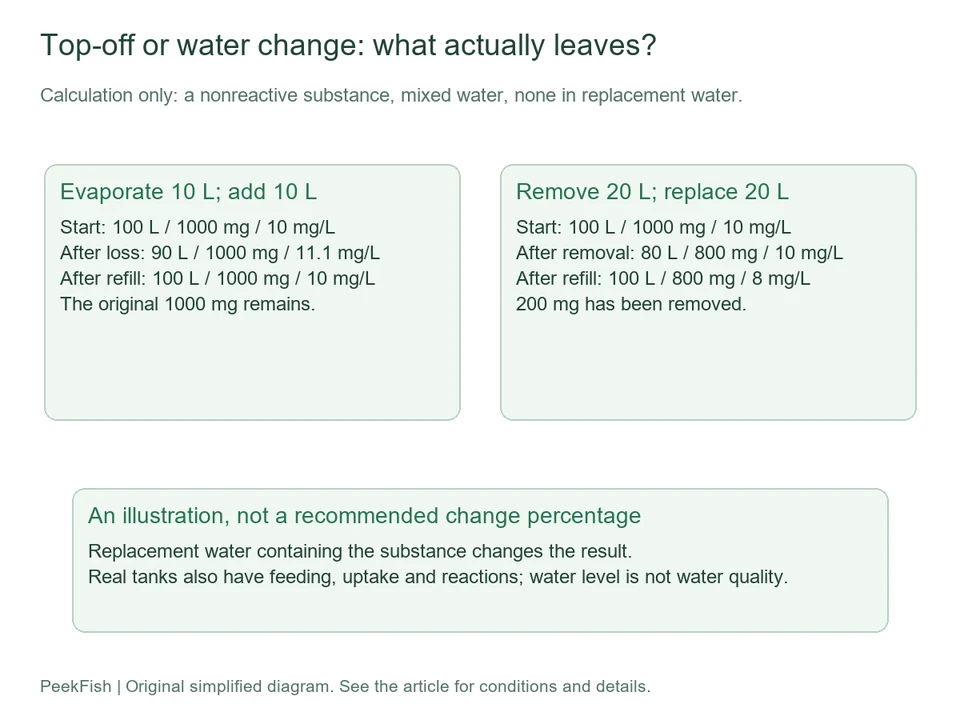
Evaporation leaves most dissolved salts behind
When water leaves as vapour, most nonvolatile dissolved salts remain. If their total amount stays approximately constant while volume falls, their concentration rises. This describes the volume effect of evaporation, not a claim that all aquarium substances remain unchanged. Feeding, uptake and biological processes continue.
Consider an imaginary container holding 100 litres and 1,000 milligrams of a nonreactive substance: 10 mg/L. After 10 litres evaporate, the remaining 90 litres contain about 11.1 mg/L. Replacing the missing volume with water containing none of that substance restores 10 mg/L but removes none of the original 1,000 milligrams. This is a calculation example, not an aquarium maintenance percentage.
Why repeated tap-water top-offs can still change parameters
If replacement water contains minerals, it adds more dissolved material. Where evaporation and replacement continue without corresponding removal, some substances can build up. The actual outcome also depends on the source, substrate, rocks, plants and maintenance, so a normal water level cannot establish unchanged water chemistry.
Choose top-off water for the existing management method and measured trends. A system using purified water for evaporation and separately prepared water for changes needs those sources clearly distinguished. A suitable purified-water top-off method does not mean replacing the entire aquarium with unprepared pure water.
How a water change can reduce accumulation
Removing part of a well-mixed volume removes the corresponding share of dissolved substances. Replacement water introduces whatever it contains. The result depends on the difference between old and new water; a water change does not lower every parameter under every circumstance.
Using the example above, removing 20 litres from 100 litres at 10 mg/L takes out 200 milligrams. Replacing it with 20 litres containing none of the substance produces about 8 mg/L. If replacement water also contains 10 mg/L, the final concentration remains about 10 mg/L. This simplified calculation ignores ongoing biological changes and illustrates why the source matters.
Choose the action for the purpose
| Situation | What needs addressing |
|---|---|
| Evaporative level loss | Restore the level appropriately; check exposed equipment and possible leaks |
| A substance keeps accumulating | Confirm measurements and sources, then assess inputs, removal and water changes |
| A sudden large level drop | Check leaks and overflow rather than assuming evaporation |
| Parameters keep drifting after top-offs | Compare source water, aquarium water and records for repeated inputs |
A marked normal water level helps track evaporation and detect abnormal losses. Top-off water still requires appropriate disinfectant treatment and temperature considerations.
This is not a marine salinity-management guide
Marine aquariums also lose water while salts remain, but their top-off and water-change arrangements must separately meet salinity and seawater-preparation requirements. Do not transfer freshwater maintenance choices directly to them. In any system, clear water topped up daily is not a reason to dispense with measurements and maintenance.
Sources
- USGS: dissolved solids, water quality and evaporation terminology
- USGS: dissolved minerals and hardness
- Aquarium Co-op: partial water changes in maintenance