The boldest fish eating enthusiastically does not prove that every fish has received enough food. First establish which food suits each animal, then watch where it goes, who swallows it and what remains. This guide covers feeding in a freshwater community aquarium. Fry, sick fish and animals requiring particular live foods need their own arrangements.
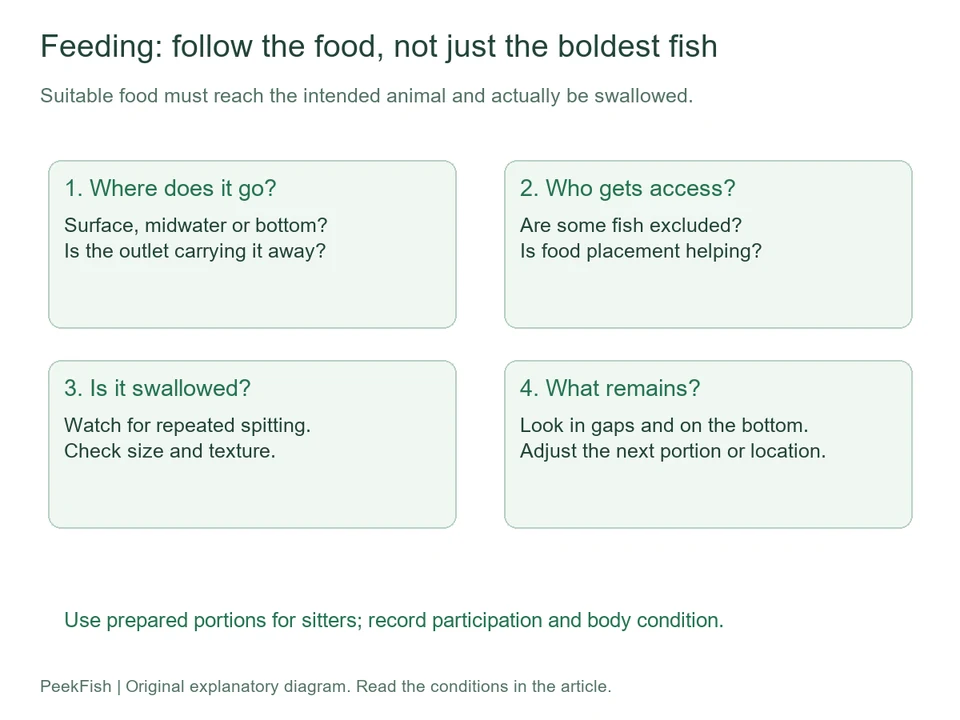
Choose suitable food before adjusting delivery
Check the species’ diet and size, and choose an appropriate complete food with any necessary supplements. Particle size, texture and sinking speed affect access. One fish may swallow a pellet whole while another can only nibble it; taking food in and spitting it out is not always simple fussiness.
Algae grazing or living near the bottom does not mean an animal can obtain a complete diet from leftovers. Nor is adding more food at the surface a reliable way to feed bottom dwellers. Separate the questions of what the fish needs and how that food reaches it.
Start with a small portion and watch four things
- Location: Does food float, suspend or sink? Is the outlet immediately carrying it into the filter?
- Participation: Are the same fish taking everything while others hide or are chased away?
- Swallowing: Is food actually swallowed, repeatedly spat out or too difficult to break up?
- Leftovers: Where does uneaten food settle? Does it disappear into rocks or dense plants?
Assess that portion before deciding whether to add more. Approaching a person or chasing food does not by itself prove hunger. Equally, not joining a feeding rush does not mean a fish needs no food. A fixed number of pellets per fish or a universal eating time cannot cover every species, life stage and food.
Change position and timing, not just total quantity
Try small portions at separated locations and observe whether competition decreases. Where a bottom dweller needs sinking food, a feeding tube or suitable tool can place it in an observable area instead of scattering it through the substrate. Not all bottom-dwelling fish feed at night; use the species’ habits and actual behaviour to choose the time.
If a fish is continually excluded, food placement is only part of the investigation. Check shelter, social interactions and whether the long-term combination is suitable. Persistent weight loss, sudden refusal or abnormal breathing calls for water-quality checks and further assessment, not an endless succession of new flavours.
Look at leftovers and longer-term condition
Remove clearly uneaten food with an appropriate small siphon or tool. Adjust the next portion or delivery location. Foods intended for extended grazing require removal timing appropriate to the product and animal; do not apply the same rule used for floating pellets. An accidental large spill is a separate incident that needs prompt removal and follow-up water testing.
Keep observations across several days: food offered, fish participating and what remained. Watch body condition as well. Newly introduced fish, juveniles and specialist feeders may have different needs; a universal fasting schedule is not a solution to every feeding problem.
Make the routine easy for another person to follow
| Record | Useful detail |
|---|---|
| Animals and food | Which fish receive which food, including any special individual |
| Portion and position | A consistent measure or prepared portion, with the feeding location marked |
| Observation | Missed food, spitting, exclusion or competition |
| Cleanup and adjustment | Where leftovers settled, what was removed and the next change to try |
Measure food into a dry small container before offering it in stages rather than tipping a whole jar over the tank. For a sitter, prepared portions and simple observations are clearer than an instruction to give “a little pinch”.
Sources
- RSPCA: fish diets and feeding
- UF/IFAS: feeding load, waste and ammonia
- Aqueon: preparing feeding arrangements for a sitter