If too much food falls into a freshwater aquarium, remove what you can find, check the animals and equipment, then monitor water quality. Fish continuing to eat is not a reason to leave a whole jar in the tank. Nor should you immediately turn over the entire substrate to recover every particle.
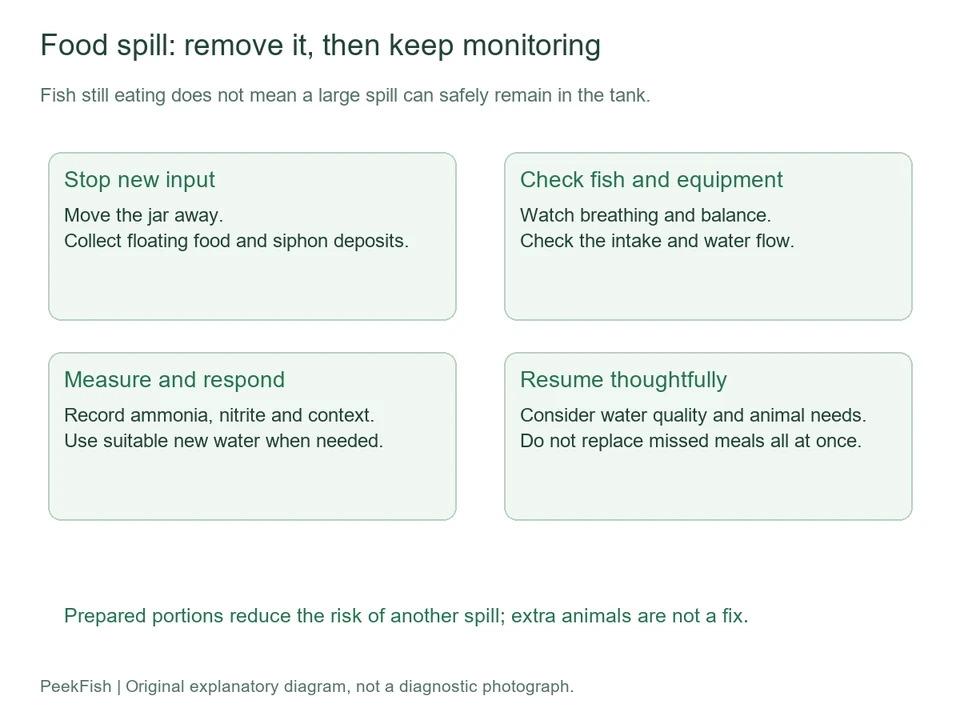
Stop further feeding and remove visible food
Move the food container away to prevent more falling in. Collect intact floating pellets or flakes with a clean tool; use an appropriate small siphon for food on the bottom and in accessible gaps. Work gently and watch fish, shrimp and fry. Avoid plunging a gravel-cleaning tube blindly into fine sand or layered planting substrate.
Siphoning removes water as well as food. Prepare suitable replacement water and record the amount removed. Prioritise obvious accumulations without exceeding the volume you can safely replace in pursuit of every hidden particle.
Check the fish and filter while cleaning
Look for food blocking the intake, pads or water path. Follow equipment instructions before disconnecting and cleaning only the affected parts; do not simultaneously replace all biological media. Rapid breathing, gathering at the outlet or loss of balance require immediate attention to breathing and water-quality problems. Do not postpone help for the fish until every piece of food has been collected.
Why testing remains necessary afterwards
Eaten food contributes to the load through fish metabolism, while remaining food continues to break down. Temporarily clear water does not rule out a developing ammonia problem. Record the approximate time and amount spilled, food type, what was removed and the actions taken. Test ammonia and nitrite, interpreting results with temperature, pH and fish behaviour.
For abnormal readings, use appropriate partial changes with reliable replacement water and retest, while confirming circulation and aeration. New water must be properly treated and suitable in temperature and chemistry. Do not rush into emptying and refilling without checking the source or treating disinfectants. Increase observation and testing as needed when measurements or animals deteriorate, and seek help promptly.
Decide when and how to resume feeding
Immediately stop additional food input. Resuming depends on cleanup, water quality, species, life stage and health. Ordinary adult fish, frequently fed fry and specialist feeders should not all receive a fixed three-day fast. Restart with a small observed portion rather than replacing several missed meals at once.
If food is trapped in a structure that cannot be safely dismantled, note its location, remove it carefully in manageable stages and monitor the situation. Large remaining deposits, a pronounced smell, persistent white cloudiness or distressed fish are reasons not to rely on the filter eventually dealing with everything.
Avoid adding several supposed fixes
- Do not add extra fish or snails to eat the spill. They add their own load and cannot guarantee removal of all food.
- Do not treat a bacterial product as permission to skip removal or testing.
- Do not combine salt, medication, clarifiers and pH adjusters without an established reason.
- After siphoning, do not forget the correct water level and restart of filtration and heating.
Reduce the chance of another spill
Measure the portion into a dry small container and add it in stages; keep the large jar away from the open tank. Give family members or sitters prepared portions, stored where children or pets cannot knock them in. Recording cleanup, subsequent measurements and recovery helps you understand the aquarium’s response to an increased load.
Sources
- UF/IFAS: feeding load, ammonia and management
- Aquarium Co-op: targeted siphon cleaning
- RSPCA: feeding and water quality