A powered filter making noise is not proof that water is circulating normally. Gradually falling output suggests checking debris and restrictions; a sudden failure after cleaning or a power interruption also calls for checking assembly, priming and equipment faults. Use this as an inspection sequence, with dismantling and priming instructions from your particular model.
Start with the fish and electrical safety
If fish are already gasping, provide suitable backup aeration where safe and keep watching them while investigating the equipment. Damaged cables, a burning smell, wet sockets, suspected electrical faults or persistent leaks require disconnection from a safe location and removal from service. Do not reach into the water to feel powered equipment.
Do not run a pump dry to test it when water is needed for cooling or lubrication. Repeated power cycling is not a substitute for identifying the fault.
Follow the water path
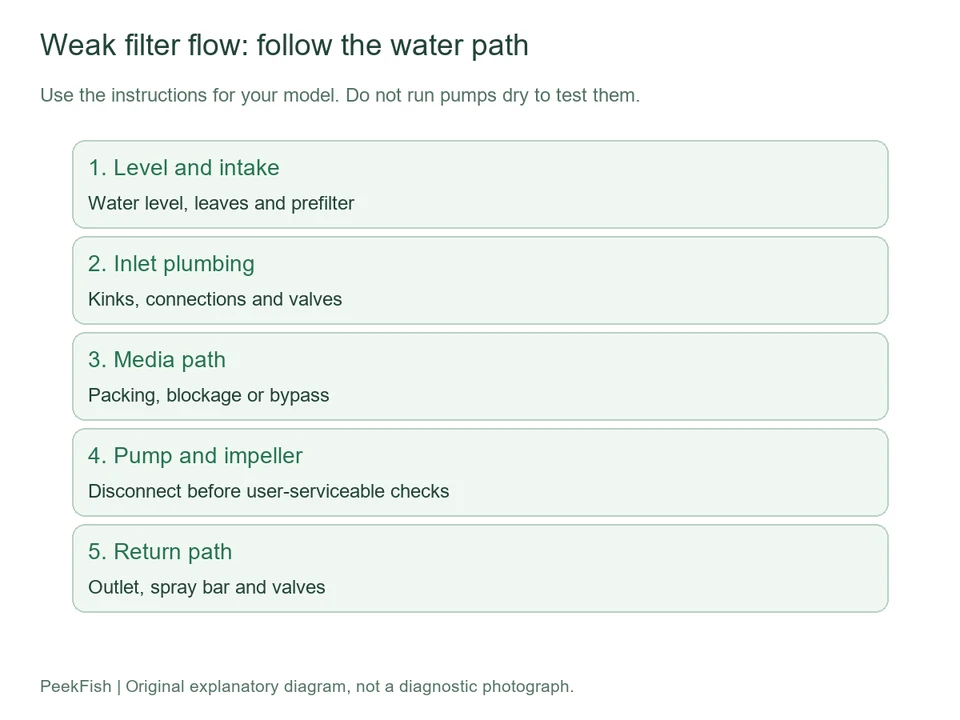
- Water level and intake: Is the level within operating requirements? Are the intake strainer or prefilter sponge obstructed by leaves or debris?
- Inlet plumbing: Are hoses kinked, compressed, connected incorrectly or restricted by valves not restored after maintenance?
- Media: Are pads compressed, overpacked or incorrectly positioned, causing bypass or obstruction?
- Pump and impeller: With power disconnected, inspect user-serviceable parts as instructed for debris, wear or incorrect assembly. Do not open sealed electrical components.
- Return path: Check the outlet, spray-bar holes and valves for obstruction or closure.
Find the section where flow is restricted instead of focusing only on the dirtiest-looking material. Clean the confirmed blockage and retain biological media that does not need attention.
No flow after cleaning: check priming and assembly
Some canister and hang-on filters need correct priming. Air-driven sponge filters instead depend on the air pump, tubing and lift arrangement. Do not transfer instructions between unrelated designs. Check water level, connections, valves and air removal according to the manufacturer. Do not suck potentially contaminated hoses by mouth or forcefully tip a heavy connected canister.
After recent maintenance, verify media baskets, impeller covers and seals. If a seal is absent, damaged or the wrong specification, do not power up simply to see whether it might work anyway.
Verify output, not just sound
Restart as instructed and confirm continuous, stable output without persistent air intake, abnormal noise or leaks. Compare with the filter’s normal operation. A pump’s nominal flow is not the same as installed flow through media and plumbing, so the box specification alone cannot diagnose a fault.
If simple obstructions have been excluded and operation is still abnormal, stop repeated trials and contact the manufacturer or a suitable repair service. Maintain appropriate temporary aeration and care, and record downtime and fish behaviour.
Check water quality after the restart
Restored flow does not prove that biological filtration is fully functioning. After downtime, dried media or substantial replacement, monitor ammonia, nitrite and the fish more closely in relation to the load. Unusual smells, abnormal media condition or prolonged stoppage require a restart decision based on the equipment and circumstances, not one universal claim about how many hours bacteria survive.
Sources
- ADA ES-150 Ver.2: installation and maintenance example (Chinese)
- Aqueon: filtration and aquarium maintenance
- UF/IFAS: biological filtration and water conditions