Brown filter media does not automatically need replacing, and weak flow is not always caused by a dirty pad. Identify what each material does before deciding whether to clean, retain or replace it. This guide covers routine freshwater filter maintenance; it does not replace the dismantling instructions for your particular model.
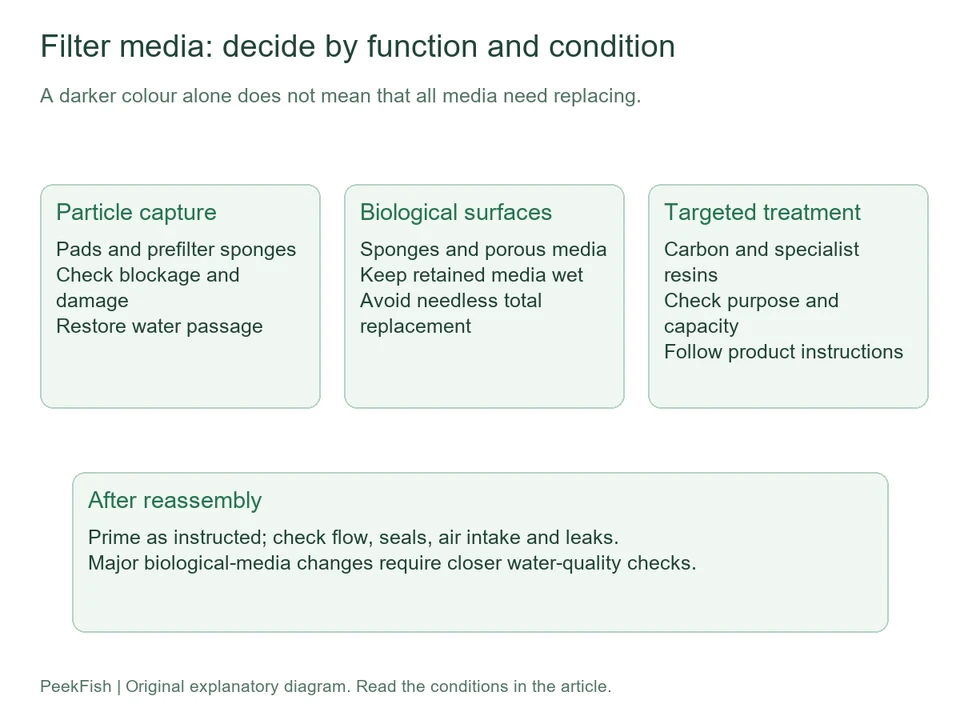
Identify the job each material performs
| Main function | Examples | What to assess |
|---|---|---|
| Trapping particles | Coarse and fine pads, prefilter sponges | Clogging, deformation and whether cleaning restores flow |
| Providing biological surfaces | Sponges and porous ceramic media | Water access, structural condition and whether wholesale replacement is necessary |
| Targeting particular dissolved substances | Activated carbon and specialist resins | Purpose, capacity and the manufacturer’s replacement or regeneration instructions |
These jobs overlap. A mechanical sponge can also support microorganisms involved in biological filtration. A name or colour alone does not define its role; consider its position in the filter and the product instructions. Adsorbent media do not remove the need for testing and maintenance.
Compare flow and blockage, not just dates
Know what normal output looks like. When it falls, first check for leaves or debris at the intake, kinked hoses and an incorrect operating water level. Then inspect the media. A darker surface is not the same as a blocked water path.
Water bypassing the media, compressed pads or damaged material deserve attention. Packing more material into a small filter is not necessarily an improvement: obstructed media may receive inadequate flow. Sudden loss of output, unusual noise or leaking should be treated as an equipment problem rather than simply another scheduled rinse.
Prepare before stopping the filter
- Have containers, cleaning tools and any necessary replacements ready. Read the model’s instructions before disconnecting and opening it.
- Remove the parts that need attention. Keep retained biological media wet; do not leave it drying on a worktop or in the sun.
- Use removed aquarium water, or appropriately dechlorinated water with similar conditions, for retained biological media. Do not use soap, detergent, hot water or disinfectant to make it look new.
- Rinse or gently squeeze as appropriate to the material. Do not force or crush media that is not designed for squeezing.
The aim is to restore water passage, not strip every surface clean. Routine cleaning and a specific disinfection protocol for an infectious problem are different procedures.
Decide what actually needs replacement
A pad that has broken down, badly deformed or remains obstructed after suitable cleaning may need replacing. Biological media also need assessment for damage, contamination that cannot be removed and product requirements. Age alone is not proof that every material has reached the end of its life.
If one cartridge provides both particle capture and most biological filtration, replacing it can change the system’s ability to process its load. Establish whether other mature biological media are present, and arrange any transition within the filter’s permitted configuration, with water-quality monitoring. Do not improvise a layout that blocks the water path. Conversely, retaining exhausted chemical media does not guarantee continued treatment.
Finish with an operating check
Reassemble in the correct order, check seals and hoses, restore the required water level and prime as instructed. Confirm steady output without persistent air intake, abnormal vibration or leaks. Record exactly what was cleaned and replaced, particularly any substantial change to biological media.
After major work, pay closer attention to ammonia, nitrite and the fish. If breathing changes or tests reveal a problem, check water flow, load and water quality rather than assuming an added bacterial product has solved it. A maintenance calendar should prompt inspection, not require replacement of the entire filter contents every time.
Sources
- UF/IFAS: biological filtration and ammonia
- MR.AQUA: filter-media maintenance (Chinese)
- ADA SUPER JET FILTER ES-150 Ver.2 instructions: model-specific example (Chinese)