 EN ▾
 ZH
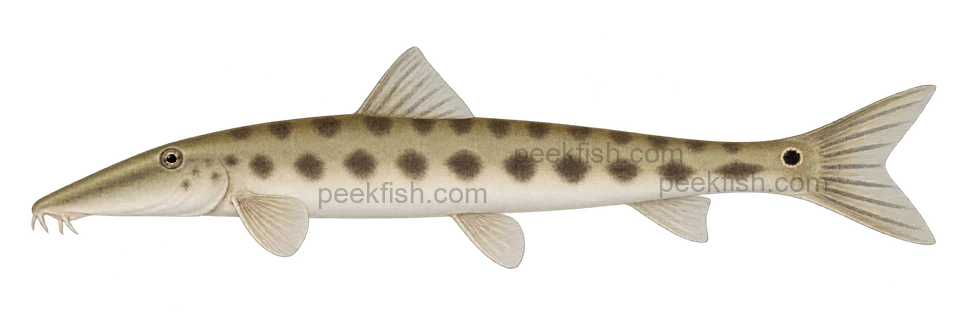
Piglet horseface loach
A long-snouted sand sifter whose upper tail-base eyespot merits a closer look.
A long sloping snout, high-set eyes and slender body create the horseface profile. Dark dorsal saddles and irregular lateral blotches contrast with a pale underside. An eyespot sits at the upper caudal base; the dorsal and forked tail can have faint bands. The 2017 revision uses labial barbels, fin rays and pattern together, not snout length or one spot alone.
- Length and basis
- Typical adult TL unknown
- Reference temperature
- Unknown
- Captive lifespan
- Unknown (no verified lifespan adopted)
- pH
- Unknown
- Hardness
- Unknown
The older SF profile lists 24–28°C, pH 6–8 and GH 1–12 dGH, but retains pre-revision taxonomy and uncertain photograph identity. These remain provisional references, excluded from verified species filter ranges. Clean, oxygenated water with some movement is the cautious layout principle; a river habitat does not require torrent-like flow. The importer documented Indonesian dialuzona in 2022, which does not authenticate every horseface trade photograph. Artwork intends a natural adult form, sex unspecified; exact maturity is not specimen-certified. Compatibility still depends on adult size, competition and confirmed water requirements. The largest examined specimen in the 2017 revision was 183.6 mm SL and 221.8 mm TL, a sample record rather than typical adult length. Glaser's approximately 15 cm over several years lacks measurement basis. Neither this nor the older SF 200 mm SL calibrates the image. Typical adult TL, illustrated TL and typical captive lifespan remain unknown.
Appearance and identification
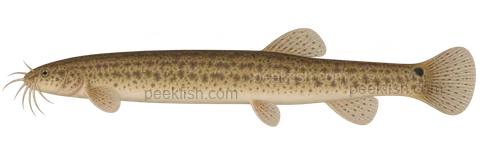
Compared with linked M. anguillicaudatus, this species has a longer snout and forked tail; the weatherloach has a blunter head, rounded tail and five pairs of oral barbels. The congener A. rungthipae is harder to separate. The 2017 revision reports usually three labial-barbel pairs in dialuzona, with zero to two in rare specimens, versus no exposed labial barbels in rungthipae. Branched dorsal-fin rays are usually 10½ versus 9½ under the paper’s counting convention; do not force counts from ordinary side photographs. Dialuzona typically has a well-developed upper caudal-base ocellus, while rungthipae usually has a small black spot. Assess lips, fin counts and pattern together, not a trade name or one black mark. Choirorhynchos remains a synonym under the 2017 revision, not another species.
Floor and movement space
Retain continuous soft sand for burrowing and feeding; secure rocks and wood before adding substrate. The older SF 120×45 cm recommendation lacks resolved species linkage here, so a species-specific minimum floor remains unknown. Small sale size is not a tank-sizing rule.
Aquarium environment
Keep open soft-sand areas in planted layouts; burrowing can disturb newly rooted plants. Shade and securely placed wood or rocks offer shelter while retaining feeding and cleaning access. Sharp coarse gravel is not a substitute for sand.
Diet and feeding
Sifting sand for small benthic animals does not replace meals. Supply suitable sinking foods and varied small live or frozen animal foods, checking feeding near refuges. It is not an algae or snail-control tool.
Same-species behaviour
Glaser's 2022 Indonesian shipment account describes grouped juveniles becoming more solitary with age, whereas older SF guidance favours groups. No single minimum group count is inferred. Provide separated resting areas and monitor chasing, feeding access and displaced individuals.
Compatibility limits
The older SF horseface-loach account suggests upper-water companions and screening bottom dwellers for territorial or aggressive behaviour. Its pre-revision identity uncertainty prevents treating this as a species-specific compatibility guarantee. Retain ample sand and shelter, clean oxygenated water with moderate movement, and check that this fish obtains sinking food. Sources disagree about keeping adults together; risk to ornamental shrimp and shrimplets is unverified.
Similar and related fish
Measurement notes and sources
The largest examined specimen in the 2017 revision was 183.6 mm SL and 221.8 mm TL, a sample record rather than typical adult length. Glaser's approximately 15 cm over several years lacks measurement basis. Neither this nor the older SF 200 mm SL calibrates the image. Typical adult TL, illustrated TL and typical captive lifespan remain unknown.
mapress.com ↗ 2026-10-22
www.aquariumglaser.de ↗ 2026-10-23
www.seriouslyfish.com ↗ 2026-10-22
api.gbif.org ↗ 2026-10-22