 EN ▾
 ZH
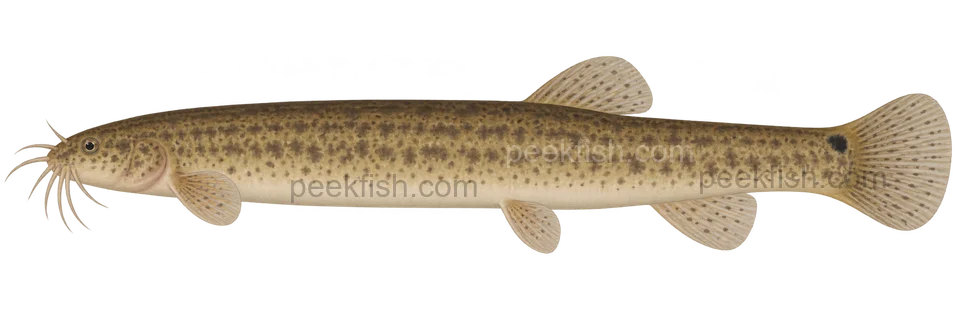
Oriental weatherloach
A mottled, round-tailed bottom dweller needing cool care and its own meals.
Yellowish to greenish brown with dark mottling and a pale underside. The nearly cylindrical body has five pairs of oral barbels, a short-based dorsal fin, a rounded tail and usually a dark spot on the upper tail base. Mature males have an enlarged second pectoral ray. Golden and pale trade forms are the same species.
- Adult length
- Up to 28 cm (standard length, without the tail fin)
- Water temperature
- 17.8–23.3 °C
- Lifespan
- Up to 10.2 years
- pH
- 6–8
- Hardness
- 1–12 dGH
- Natural habitat
- Inhabits shallow slow river reaches, swamps, oxbows, backwaters and rice fields, usually over soft mud or silt with vegetation, roots or leaves.
Keep at 17.8–23.3°C, pH 6–8 and GH 1–12 dGH (roughly 18–23°C). Do not keep it at prolonged tropical heat. Maintain stable clean water, gentle flow and oxygenation; air gulping is not a reason to accept low oxygen. Reaches 280 mm SL.
Appearance and identification
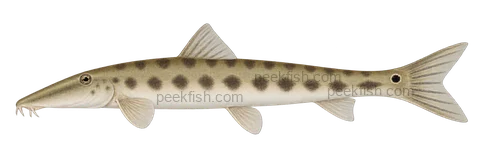
Compared with A. dialuzona, the head is blunter and the tail rounded rather than long-snouted and fork-tailed. The similar Paramisgurnus dabryanus generally has higher fatty crests on the caudal peduncle and lacks the upper tail-base spot. Mislabelled and hybrid fish occur in trade, so do not rely on colour alone.
Floor and movement space
At least 120×45 cm floor for long-term care, with room for burrowing, turning and resting and free access to the surface. Provide soft sand or smooth fine substrate, secure decor, protected intakes and a tight escape-proof lid.
Aquarium environment
A cool, sheltered planted layout with soft substrate and open feeding areas. Burrowing can disturb shallow-rooted plants, so secure decor first. Tolerance of poor conditions does not remove the need for maintenance.
Diet and feeding
Offer sinking meals with small live or frozen foods, and check that hidden individuals eat. It eats benthic invertebrates, algae and detritus, but leftovers are not enough and it is not a cleaner.
Same-species behaviour
Can be kept singly but is more active with its own kind. Provide space and watch feeding competition. Active feeding can disturb slow fancy goldfish, so they are not ideal companions.
Compatibility limits
Eggs, fry and very small fishes may be eaten. Established introduced populations exist, so prevent escape and never release it into the wild.
Similar and related fish
Sources
www.seriouslyfish.com ↗ 2026-10-22
fishesofaustralia.net.au ↗ 2026-10-23
australian.museum ↗ 2026-10-23
api.gbif.org ↗ 2026-10-22