 EN ▾
 ZH
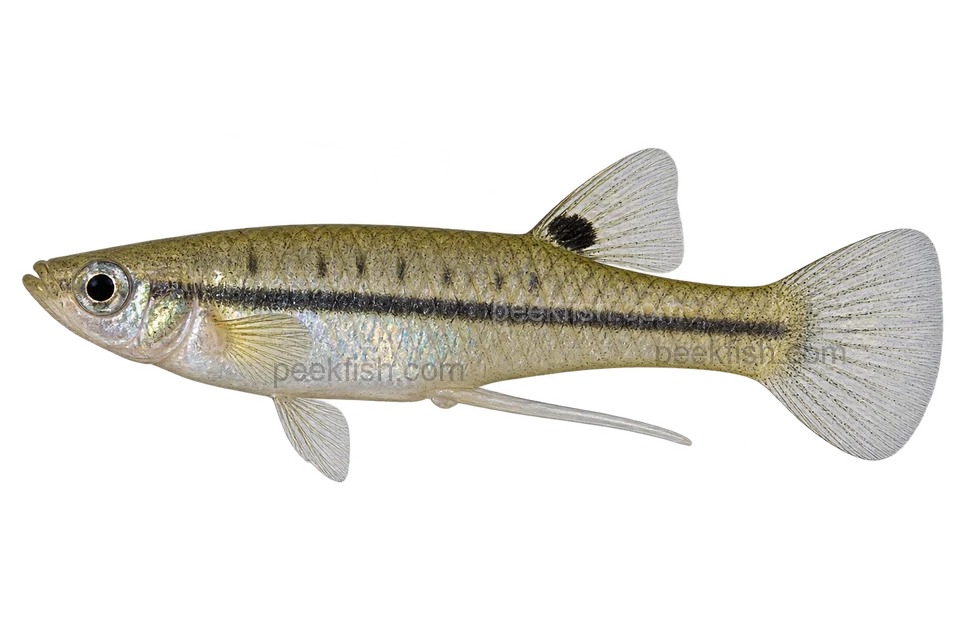
Least killifish
A dark horizontal stripe and dorsal spot stand out; tiny males have a long gonopodium.
- Length and basis
- 2 cm SL · source observation
- Reference temperature
- 20–26 °C
- Captive lifespan
- Unknown (no verified lifespan adopted)
- pH
- 7–8 (source care reference)
- Hardness
- 5–20 dGH (source care reference)
Peaceful fish can still be eaten or outcompeted; provide planted cover and gentle flow.
Appearance and identification
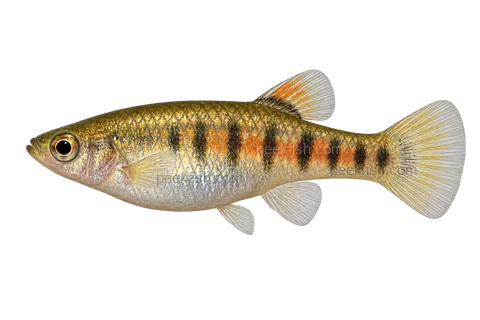
The representative pattern is a dark horizontal flank stripe with a dorsal spot, contrasting with the short bars and orange areas of N. elegans. Males are substantially smaller than females and have a prominent long gonopodium. The male illustration and male size record do not represent female appearance or size.
Same-species behaviour
Seriously Fish recommends a small colony. Males may show mild aggression while competing for females; the profile describes actual injuries as rare. This does not establish a universal group count or sex ratio; source-specific space and group context is listed separately.
Space requirements
A retailer gives over 54 L, a 60 cm swimming length and at least 10 fish as a group reference, without a sex ratio or complete footprint. This is not a validated stocking capacity.
Diet and feeding
Use fine complete foods, suitable live foods and a plant component.
Compatibility limits
Their small size, especially in males, leaves them vulnerable to being eaten by larger aquarium fish and outcompeted by vigorous companions. Seriously Fish lists similarly sized, non-predatory fish and freshwater shrimp as candidates. This does not verify safety for every shrimp species or juvenile shrimp; juvenile-shrimp risk remains unknown.
Aquarium environment
Seriously Fish recommends dense planting and gentle filtration with minimal water movement. Garnelaxia also suggests hiding places such as wood and rock structures. These are cover and flow recommendations; damage to particular plant species remains unknown.
Similar and related fish
Measurement notes and sources
The source lists 2 cm standard length, excluding the tail, with statistic unspecified; male context, not a female maximum. Typical adult total length remains unknown.
www.seriouslyfish.com ↗ 2026-10-22
www.garnelaxia.at ↗ 2026-10-22
pmc.ncbi.nlm.nih.gov ↗ 2026-10-22
api.gbif.org ↗ 2026-10-22