 EN ▾
 ZH
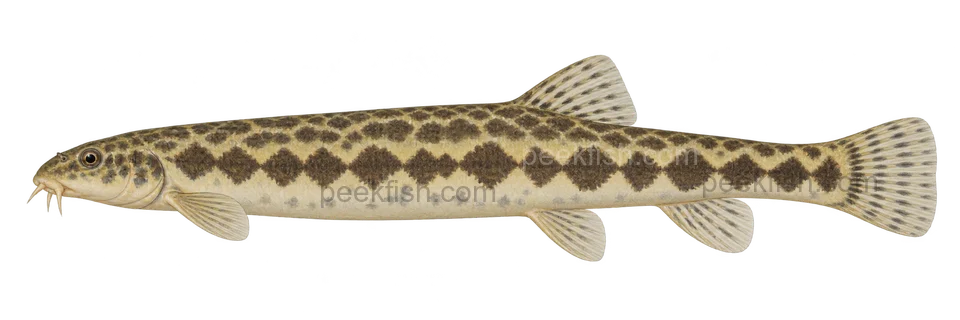
Ajime loach
An elongated stone grazer with irregular flank blotches and a fleshy mouth.
A small head, fleshy downward mouth and three pairs of short barbels accompany a slender body with posterior dorsal, pelvic and anal fins. A dark longitudinal stripe or irregular connected flank blotches can occur; dorsal and lower-flank markings vary among populations.
- Adult length
- Up to 9.5 cm
- Water temperature
- 20–24 °C
- pH
- 6.5–7.5
- Hardness
- 0–8 dGH
- Natural habitat
- Inhabits clear, shallow, fast, oxygen-rich headwaters and tributaries over stones, sand, gravel and boulders.
Keep at 20–24°C, pH 6.5–7.5 and GH 0–8 dGH. Clean, oxygen-rich moving water is essential; extra aeration does not make warmer temperatures safe. Reaches 110 mm SL.
Appearance and identification
Compared with M. anguillicaudatus, the barbels are shorter, the mouth more specialised for stone-surface feeding and the body and rear fins more slender. It differs from similar Cobitis in lacking a dark snout band and having more posterior fins. Use these characters together rather than pattern alone.
Floor and movement space
At least 90×30 cm floor with mature biofilm-covered smooth stones, sheltered resting areas and an escape-proof cover.
Aquarium environment
Plants attached to hardscape suit flowing water, but keep illuminated mature grazing stones and crevices. A newly assembled clean planted tank lacks mature biofilm. Protect intakes and seal climbing or escape gaps.
Diet and feeding
Grazes attached algae, particularly diatoms. Supplement mature biofilm with accepted foods and check that it is eating; modest suitable animal foods add variety. Grazing does not replace feeding or guarantee removal of black brush algae.
Same-species behaviour
Keep at least 4 of its own kind; mild territorial disputes occur. Provide several feeding stones and watch weaker individuals.
Compatibility limits
Tankmates must tolerate clean, oxygen-rich moving water. After meeting each species' space needs, keep mature grazing surfaces and quieter resting areas for this loach. Likely peaceful, with mild territorial disputes among its own kind. Too many other grazers can deplete biofilm: monitor intake and condition, and avoid food competition while weakened fish recover.
Similar and related fish
Sources
www.seriouslyfish.com ↗ 2026-10-22
www.pref.kyoto.jp ↗ 2026-10-23
jmapps.ne.jp ↗ 2026-10-23
kyushu-u.elsevierpure.com ↗ 2026-10-23
api.gbif.org ↗ 2026-10-22