 EN ▾
 ZH
Doping-doping ricefish
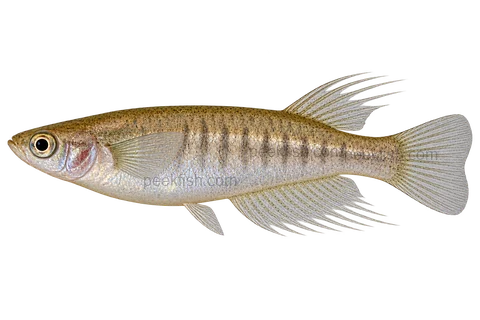
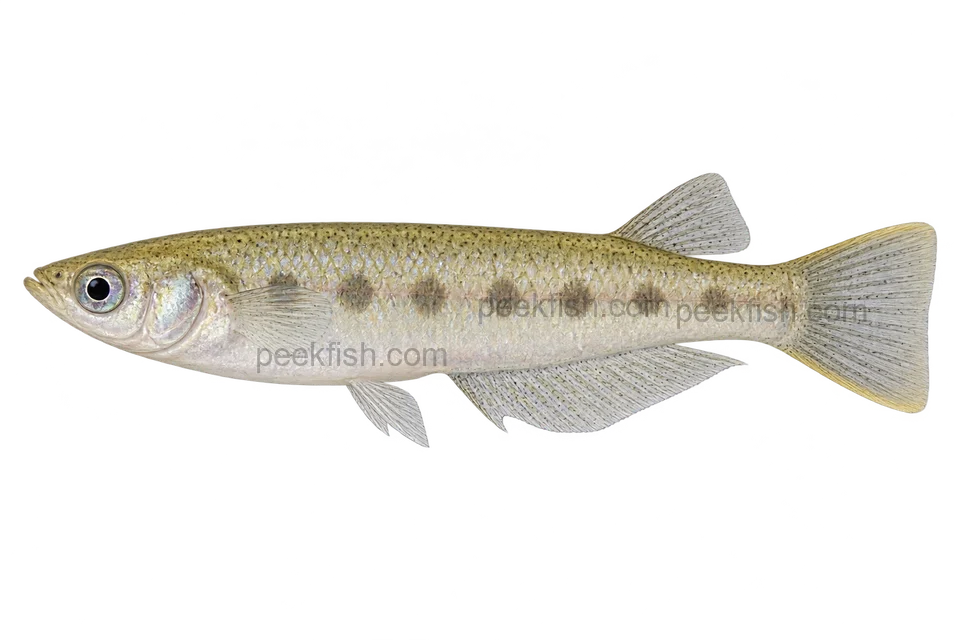
Male flank blotches darken during courtship; eggs are not brooded until hatching.
A freshwater ricefish from Sulawesi’s Doping-doping River. Natural males carry diffuse flank marks that intensify in courtship; the authors’ poster records five to eight blotches or short bars. Ordinary and courtship colours do not represent different species.
- Adult length
- Up to 3.6 cm (standard length, without the tail fin)
- Water temperature
- 24–28 °C
Evidence chiefly concerns research stocks and public aquaria; broad retail availability has not been established. Darkening can accompany courtship, so colour intensity alone does not diagnose health or a domestic strain.
Appearance and identification
The original study places it near O. eversi and O. sarasinorum, yet its reproductive strategy differs: it does not retain a pelvic brood until hatching. Yellow-silver colour and flank marks aid browsing, while exact identification requires locality and structural characters.
Same-species behaviour
Minimum conspecific numbers and an appropriate sex ratio are unknown. Watch courtship chasing and retreat as male spots darken; nuptial colour does not establish schooling behaviour. Do not transfer the special more-than-ten advice for O. nigrimas.
Space requirements
Research Table2 gives adult references of 45 L and 0.12 m² base. Tank length, sex composition and capacity thresholds are not independently validated. A middle-river origin does not justify an assumed high-flow setup.
Diet and feeding
Research husbandry supports ingestible particles and small live food but does not validate a separate feeding frequency for this species. The several-small-meals exception for lake-dwelling O. nigrimas is not a fact about this fish; adjust from intake and water quality.
Compatibility limits
Phylogenetic proximity does not demonstrate compatibility with O. eversi or O. sarasinorum. Species-specific community and shrimp-safety evidence is absent; maintain traceable breeding stocks and avoid uncertain mixed identities.
Aquarium environment
As a transfer brooder it can use plants or a spawning mop for egg attachment. Do not plan it as the full-term pelvic brooder O. eversi. Check fry feeding separately rather than assuming identical requirements across small ricefishes.
Similar and related fish