Visible food and debris on the bottom usually call for targeted cleaning, not catching all the fish and washing the entire substrate outside the tank. Identify the substrate first, then control the intake position and water removed. This guide does not cover a complete rebuild, contamination incident or professional disinfection procedure.
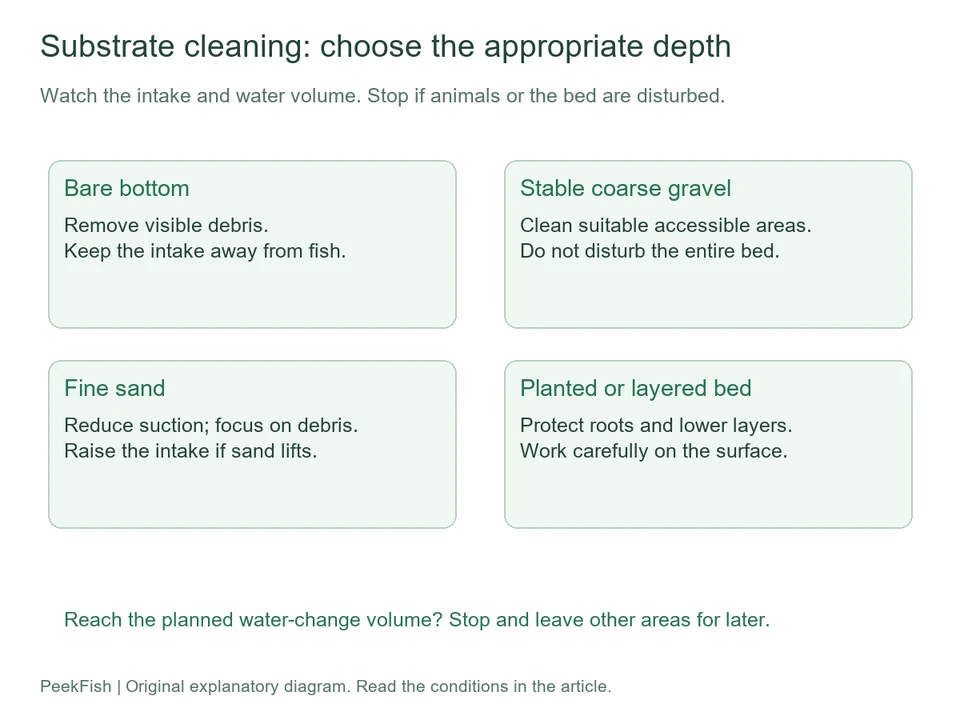
Match the method to the bottom
| Bottom type | Routine approach | Avoid |
|---|---|---|
| Bare bottom | Remove visible debris from accessible surfaces and corners | Chasing fish or placing the intake against an animal |
| Stable coarse gravel | Use a gravel-cleaning tube in areas suitable for cleaning | Turning over large areas at once or striking the tank base |
| Fine sand | Reduce suction and focus on surface debris | Continually drawing sand into the waste bucket |
| Planting substrate, layers or deep beds | Carefully clean the surface and accessible areas | Plunging through roots and disrupting the lower layers |
These are choices of technique, not a requirement to deep-clean every substrate. Material instructions, roots and the habits of the animals determine where it is appropriate to work.
Keep drainage under control
Prepare an aquarium-only bucket, a siphon suited to the tank and a clip to secure the outlet. The discharge end needs to be below the aquarium water surface for gravity siphoning. Start it using the tool’s instructions, such as a priming bulb or water-filled hose, rather than sucking by mouth. Stabilise the bucket and mark the planned water-change amount.
Before lowering the level, handle heaters and pumps that may become exposed according to their instructions. Check for fry, small shrimp and bottom-dwelling fish. An intake guard can reduce cleaning performance and become clogged; fitting one does not remove the need to watch the intake.
Work on one small area at a time
- Begin with visible debris in an accessible area instead of moving every decoration.
- Keep an intake distance appropriate to the substrate. If substantial sand is being removed rather than waste, reduce flow or raise the intake immediately.
- Stop to check before approaching roots, layered material or a gap you cannot see into. Do not push down blindly.
- Watch the receiving bucket. Stop at the planned water-change volume and leave remaining areas for a later session if necessary.
If suction draws an animal toward the opening, stop the siphon immediately before gently freeing it. If a large area is disturbed, debris suddenly spreads or fish behave abnormally, stop further disturbance and assess the fish, circulation and water quality.
A difficult corner does not always require dismantling
Change the cleaning angle behind wood or rocks only where it will not destabilise the structure or injure animals. Do not suddenly move supporting stones or established rooted planting merely to achieve a spotless appearance. Repeated buildup in a hard-to-reach place is a reason to review circulation and maintenance access, rather than remove more water every session.
Refill with appropriately prepared water, restart equipment and verify flow. Record the area cleaned and litres removed. At the next session, check whether debris returns to the same place and whether food repeatedly lands there. Those observations can guide a more useful adjustment than repeated deep cleaning.
Sources
- Aquarium Co-op: siphon and gravel-cleaner operation
- Petco: gravel-vacuum use and animals near the intake
- Aqueon: routine aquarium care