Whether an aquarium needs heating, and to what temperature, depends on the species and actual water conditions. “Tropical” and “coldwater” are not sufficiently precise control instructions, and touching the glass is not a temperature measurement. This guide covers indoor freshwater equipment checks, not outdoor pond overwintering.
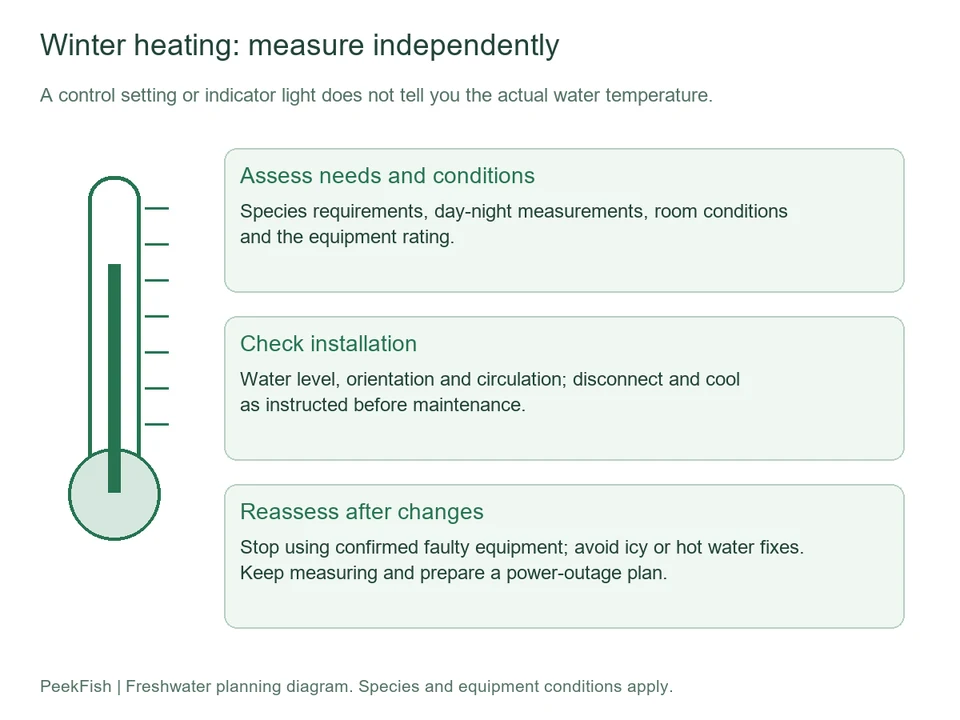
Measure the actual temperature pattern
Use a reliable independent thermometer during the day, at night and when room heating changes. Establish appropriate conditions from the species’ requirements. A heater dial is a setting and its light indicates an operating state; neither establishes the actual water temperature.
Verify an unexpected reading with another reliable method and check whether the thermometer’s position is representative. Do not turn the control to maximum in response to a single low reading.
Match equipment to its operating conditions
Use the manufacturer’s specifications for actual water volume, required temperature difference, installation and environment. Two tanks of the same size can need different heating capacity in warm and cold rooms. A universal watts-per-litre rule does not cover every situation. Undersized equipment may run continuously without reaching the target; a thermostat fault cannot be resolved by repeatedly raising its setting.
Check installation and maintenance requirements
- Confirm immersion requirements and any minimum or maximum water-level markings for the model.
- Check suitable surrounding flow, secure placement and whether materials cover or contact the heater inappropriately.
- Inspect the casing, guard and cable; check electrical connections for water or other hazards.
- Before draining or cleaning, disconnect and cool as instructed. Never run the heater dry or lift a hot powered tube out of the water.
Permitted orientation and immersion vary. Another model being safe to use horizontally does not establish that yours can be installed that way.
Investigate low and rising temperatures differently
Too low: Verify power, the thermometer, setting, actual water level and local flow. Then assess whether the equipment is rated for the room conditions. Stop using confirmed faulty equipment and replace it appropriately; do not open sealed electrical components.
Continuing to rise: If the heater or controller is confirmed faulty, safely stop the defective heating device and continue measuring while investigating. Do not counter it with a large addition of icy water. Abnormal breathing or activity also calls for oxygen and water-quality checks and timely assistance.
Plan insulation together with outage arrangements
Reducing cold draughts, improving room conditions and limiting unnecessary heat loss can reduce the load, but do not seal off required gas-exchange routes. Consider respiratory habits, jump prevention and equipment requirements when covering a tank.
Prepare for power interruptions and test what backup power can actually run. A heater usually uses much more power than a small air pump, so an aeration runtime is not a heating runtime. Check that backups start before cold weather or travel.
Recheck across the normal daily cycle
After adjustments, record day and night temperatures, equipment operation and animal behaviour. Look for overshoot or repeated swings. Recheck when seasons change, room heating changes or water is replaced. A setting that worked previously does not remove the need to measure again.
Sources
- RSPCA: winter fish care
- Fluval T-series: installation and temperature verification
- Tetra HT: heater use and safety instructions