A little attached algae can be part of an established aquarium. Growth that obstructs viewing, shades plants, blocks equipment or repeatedly gets out of hand deserves investigation. Identify where it grows and how it attaches, then review lighting, feeding and maintenance. This freshwater guide is a troubleshooting process, not a visual identification key for every kind of algae.
Separate green water from growth on surfaces
Observe a water sample in a clean container. Uniformly green water belongs in a green-water investigation. If the water is relatively clear and growth is on glass, wood, rocks or leaves, record its location, appearance and how easily it wipes away. Take both a wider view and close photographs. One green patch is not enough to establish a cause.
| Visible form | Useful observations | Before cleaning |
|---|---|---|
| Film, dust or spots | Lit surfaces affected and time until regrowth | Match tools to the tank material; trapped grit can scratch |
| Threads or tufts | Attachment to plants, equipment or quieter corners | Remove gently without uprooting plants |
| Slippery sheets or mats | Colour, spread, location and circulation | Do not identify or select a treatment from colour alone |
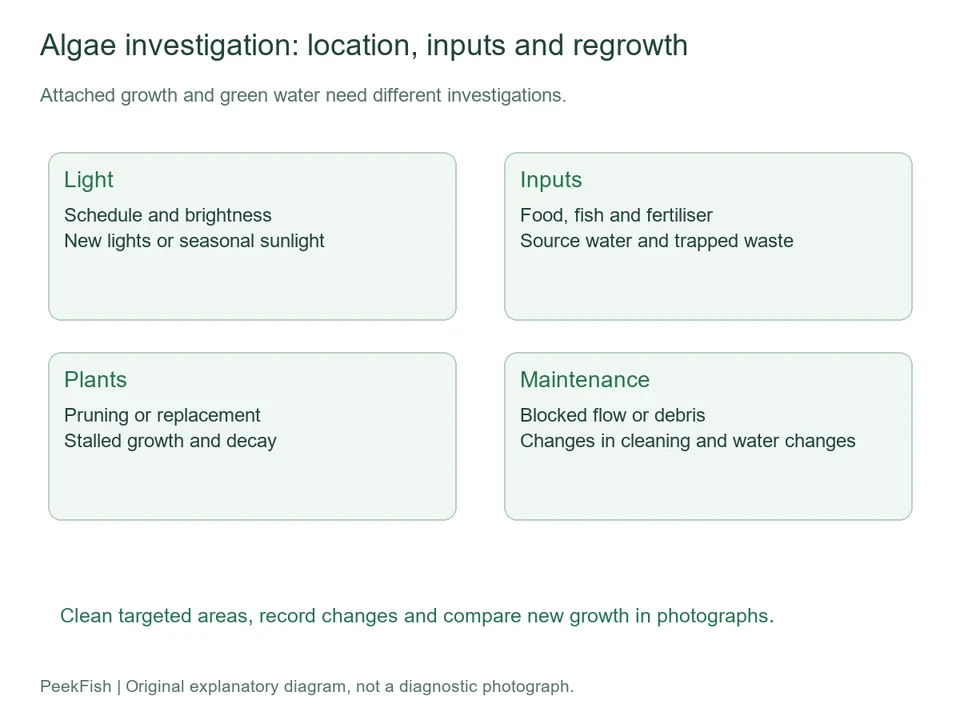
Review four kinds of change
- Light: What is the actual daily schedule? Has a light been added or increased, or has seasonal sunlight reached the tank?
- Inputs: Have fish, food or fertiliser increased? Does food accumulate somewhere inaccessible? Does source water contribute relevant nutrients?
- Plants: Has there been extensive pruning, replacement, stalled growth or decay? Plants do not automatically prevent algae.
- Maintenance and flow: Has filter output fallen, debris accumulated or the cleaning and water-change routine changed?
Interpret measurements in the context of the setup. Planted aquariums need nutrients available to their plants; forcing nitrate and phosphorus to zero is not a universal algae-control target. Low readings alone also do not prove that inputs and plant growth are well matched.
Clean confirmed problems and adjust with records
Remove growth interfering with viewing or plants and siphon out loose debris. Trim severely damaged or decaying plant material appropriately. Restore blocked water paths. Keep a stable lighting routine and address observed problems rather than abruptly depriving plants of suitable light for a prolonged period.
Record cleaning and changes, and compare new growth from the same photo position. Changing the light, stopping fertiliser, adding chemicals and introducing animals simultaneously makes it difficult to learn what helped. Do not delay an urgent animal-welfare issue for a controlled experiment, but ordinary algae maintenance benefits from deliberate steps.
Algae-eating animals are not universal cleaning equipment
Fish, shrimp and snails eat different things and have their own dietary, space and social requirements. A fish that grazes attached growth may not clear green water and may not suit the tank’s temperature or inhabitants. Consult the actual species profile before adding it instead of buying from a “cleaner” label.
Know when better identification is needed
Rapidly spreading growth, persistent plant damage, blocked flow or abnormal fish behaviour calls for clearer photographs, recent history and relevant measurements. Before using an algae treatment, check its ingredients, intended system, dose and restrictions for fish, shrimp, snails and plants. Another keeper’s bottle and dose are not automatically transferable to your aquarium.
Sources
- Aqueon: lighting, nutrient inputs and nuisance algae
- Practical Fishkeeping: an algae investigation in a particular planted setup
- Aquarium Co-op: green water and other cloudy appearances