Cloudy aquarium water has more than one possible cause. Check the fish first, then separate water colour, suspended particles and deposits on the glass. These observations help decide what to test and clean; colour alone cannot establish water quality or a diagnosis. This guide covers initial checks in freshwater aquariums.
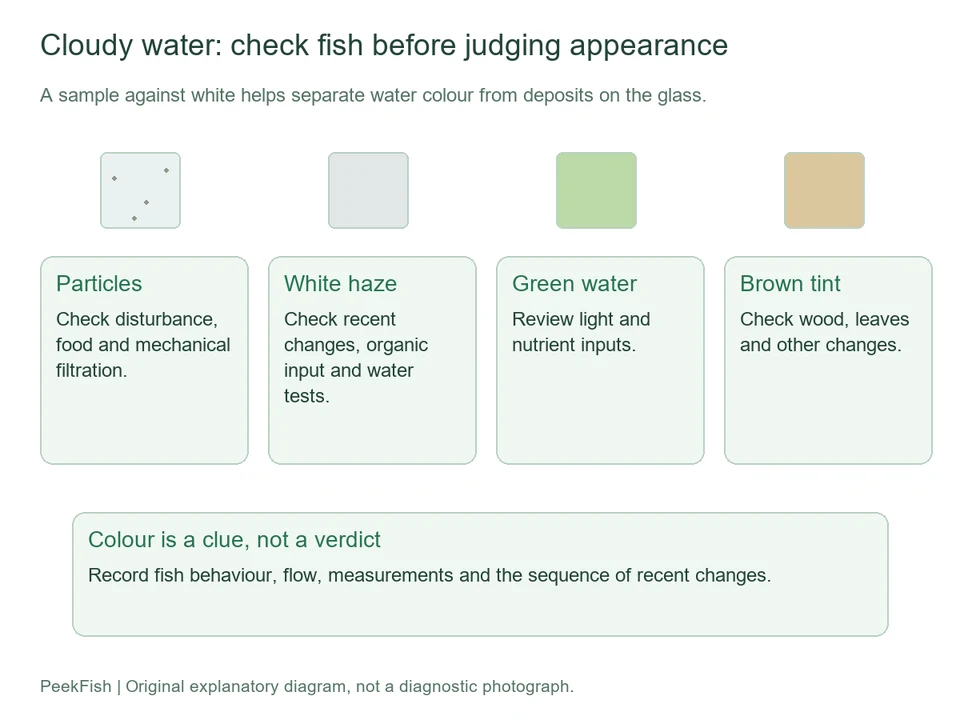
First check whether the fish are affected
If several fish suddenly breathe rapidly, gather at the outlet, lose balance or die, treat the situation as a potentially urgent environmental problem. Verify filtration and aeration, and safely restore suitable surface movement or additional aeration. Check actual temperature, recent water additions and treatments, and test relevant parameters including ammonia and nitrite. Do not wait for deteriorating fish because white cloudiness sometimes clears by itself.
If accumulated harmful substances are suspected, an appropriate partial change with reliably prepared water can help, followed by monitoring. Replacement water must be suitably dechlorinated and matched to the aquarium’s conditions. Investigate a questionable source first. Persistent distress, acute deaths or suspected contamination warrant prompt help from an aquatic veterinarian or experienced professional.
Is the water cloudy, or is the glass obscuring the view?
Take a small sample in a clean container and view it against white. If the sample is clear but the view through the tank is hazy, inspect deposits inside and outside the glass, scratches and reflections. Do not spray household cleaners near an open aquarium. Use tools appropriate to glass or acrylic.
| Observation | What to check next | What it does not prove |
|---|---|---|
| Visible suspended particles | Recent siphoning, substrate disturbance, feeding, pads and flow | That everything is bacteria or harmless |
| Even milky or grey-white haze | Tank age, organic input, filter changes, fish and tests | That adding bacteria will necessarily solve it |
| The water itself is green | Sunlight, lighting changes, feeding, source water and nutrient input | That algae-eating fish will clear the water |
| Transparent yellow-brown tint | New wood or leaves, unusual smell and animal behaviour | That it is definitely toxic or definitely harmless |
Write down what changed before the haze appeared
Were fish added, cartridges replaced, gravel washed, food spilled, power interrupted or a new water treatment used? A timeline is more useful than immediately declaring that the biological filter has crashed. If several interventions are necessary, record their order. Unrecorded water changes, media replacement, bacteria and medication together make later interpretation difficult.
Reduce the likely input while retaining useful filtration
Mainly particles: Remove visible food and decaying material. Check mechanical media for blockage, incorrect placement or bypass. Avoid stirring the whole substrate during spot cleaning. After cleaning a pad, confirm that water actually passes through it; a running motor is not enough.
Mainly white haze: Reduce unnecessary organic input and assess filtration and water quality. If fish remain stable and relevant tests show no problem, continued observation may allow recovery. Deteriorating fish or measurements call for action on the identified issue. A blanket instruction never to change cloudy water is inappropriate.
Green or yellow-brown water: Investigate light and nutrient inputs, or substances released by wood and leaves, respectively. Do not begin by hiding the appearance with a clarifier. Chemical media and other equipment address particular problems; their use does not prove that the environment is suitable. Growth attached to surfaces belongs in the attached-algae investigation.
Measure improvement beyond clarity
Photograph from the same position and lighting, and record visibility, breathing, activity, water readings and flow. Clearer water with distressed fish means the investigation is not finished. Stable fish in water that is not yet crystal clear do not automatically require repeated deep cleaning. Aim to restore appropriate conditions and understand any recurrence.
Sources
- Aquarium Co-op: different cloudy-water appearances
- UF/IFAS: ammonia testing and management
- UF/IFAS: environment and fish health